A serverless H100 lists at $5.39 an hour against $1.99 to $3.99 for an H100 pod, but serverless bills only the seconds a worker runs. The full rate card side by side, the busy-hours break-even for every tier, and the settings that quietly add to the bill. Read on Runpod's own pages, Nov 3, 2026.
Some links on this page are referral links: we may earn a commission, at no cost to you.
Share
Runpod Serverless costs more per hour than a pod, but it only bills the seconds a worker is running. On Runpod's pricing page (read November 3, 2026), a serverless H100 flex worker is $5.39 an hour; an H100 pod is $1.99 an hour (H100 PCIe, Community Cloud) to $3.99 an hour (H100 SXM, Secure Cloud). A pod bills every hour it's on, busy or not. Serverless scales to zero, so it's the cheaper choice whenever your GPU is genuinely busy for fewer than about 9 to 18 hours a day, depending on which pod you'd otherwise rent.
Runpod Serverless vs a pod in four numbers (runpod.io, read Nov 3, 2026)
$5.39
Serverless H100
H100 flex worker, per hour
$1.99
Cheapest H100 pod
H100 PCIe, Community Cloud
5
Idle timeout, seconds
Default in the Runpod console
$80
Spend limit per hour
Default across all resources
How much does Runpod Serverless cost per hour?
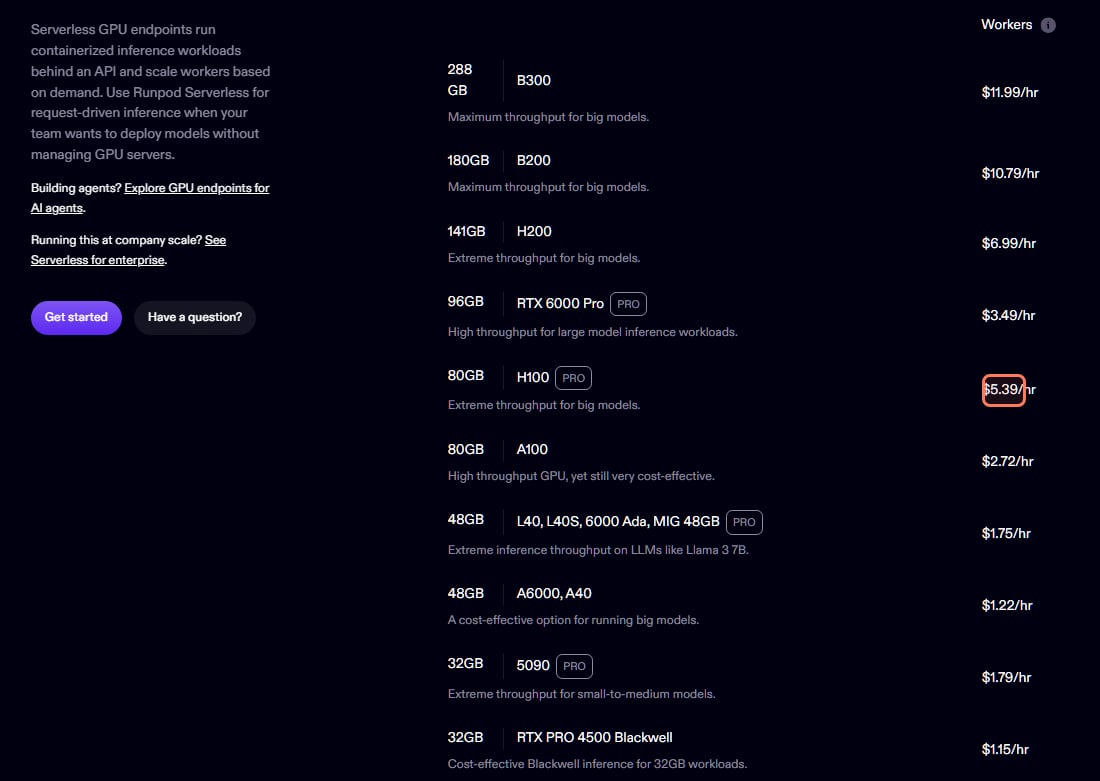
From $0.58 an hour for a 16GB worker to $11.99 for a B300. These are Runpod's published flex rates (workers that scale to zero), read on its pricing and Serverless pages on November 3, 2026. You pay the same rate per second: the hourly figure divided by 3,600, so an H100 worker costs about $0.0015 for every second it runs.
Runpod's own Serverless rate card (runpod.io/product/serverless), read Nov 3, 2026. The H100 row is outlined. · Screenshot of runpod.io by aliteq
The full flex rate card, with the closest pod on the same pricing page next to it:
Runpod Serverless (flex) vs a Runpod pod, per hour (runpod.io/pricing, read Nov 3, 2026)
16GB (A4000, A4500, RTX 4000, RTX 2000)
Serverless worker tier
$0.58
Serverless flex
Not listed on the pod table
24GB (L4, A5000, 3090, MIG 24GB)
Serverless worker tier
$0.75
Serverless flex
RTX 3090 $0.22 / $0.50
24GB PRO (4090)
Serverless worker tier
$1.34
Serverless flex
RTX 4090 $0.34 / $0.89
32GB PRO (5090)
Serverless worker tier
$1.79
Serverless flex
RTX 5090 $0.69 / $1.19
48GB (A6000, A40)
Serverless worker tier
$1.22
Serverless flex
RTX A6000 $0.33 / $0.59
48GB PRO (L40, L40S, 6000 Ada, MIG 48GB)
Serverless worker tier
$1.75
Serverless flex
L40S $0.79 / $1.09
A100 80GB
Serverless worker tier
$2.72
Serverless flex
A100 PCIe $1.19 / $1.79
H100 80GB PRO
Serverless worker tier
$5.39
Serverless flex
H100 PCIe $1.99 / $2.89; H100 SXM $2.69 / $3.99
RTX 6000 Pro 96GB
Serverless worker tier
$3.49
Serverless flex
RTX Pro 6000 $1.69 / $2.49
H200 141GB
Serverless worker tier
$6.99
Serverless flex
H200 $3.59 / $5.29
B200 180GB
Serverless worker tier
$10.79
Serverless flex
B200 $5.98 / $7.99
B300 288GB
Serverless worker tier
$11.99
Serverless flex
B300 $6.94 / $8.99
Serverless worker tier
Serverless flex
Closest pod (Community / Secure Cloud)
16GB (A4000, A4500, RTX 4000, RTX 2000)
$0.58
Not listed on the pod table
24GB (L4, A5000, 3090, MIG 24GB)
$0.75
RTX 3090 $0.22 / $0.50
24GB PRO (4090)
$1.34
RTX 4090 $0.34 / $0.89
32GB PRO (5090)
$1.79
RTX 5090 $0.69 / $1.19
48GB (A6000, A40)
$1.22
RTX A6000 $0.33 / $0.59
48GB PRO (L40, L40S, 6000 Ada, MIG 48GB)
$1.75
L40S $0.79 / $1.09
A100 80GB
$2.72
A100 PCIe $1.19 / $1.79
H100 80GB PRO
$5.39
H100 PCIe $1.99 / $2.89; H100 SXM $2.69 / $3.99
RTX 6000 Pro 96GB
$3.49
RTX Pro 6000 $1.69 / $2.49
H200 141GB
$6.99
H200 $3.59 / $5.29
B200 180GB
$10.79
B200 $5.98 / $7.99
B300 288GB
$11.99
B300 $6.94 / $8.99
Is Runpod Serverless cheaper than a pod?
Only if your GPU sits idle a good part of the day. A pod bills every hour it's switched on. Serverless bills per active second at a higher rate. So the deciding number is how many hours a day your endpoint is really busy, counting cold starts and idle-timeout seconds.
The break-even is simple: busy hours per day = 24 × pod rate ÷ serverless rate. Below that number, serverless is cheaper. Above it, the pod is.
Break-even: busy hours a day where Serverless costs the same as a pod left on 24/7
24GB (RTX 3090 pod)
GPU
7.0 h
vs Community Cloud pod
16.0 h
24GB PRO (RTX 4090 pod)
GPU
6.1 h
vs Community Cloud pod
15.9 h
32GB PRO (RTX 5090 pod)
GPU
9.3 h
vs Community Cloud pod
16.0 h
48GB (RTX A6000 pod)
GPU
6.5 h
vs Community Cloud pod
11.6 h
48GB PRO (L40S pod)
GPU
10.8 h
vs Community Cloud pod
14.9 h
A100 80GB (A100 PCIe pod)
GPU
10.5 h
vs Community Cloud pod
15.8 h
H100 (PCIe $1.99 / SXM $3.99 pod)
GPU
8.9 h
vs Community Cloud pod
17.8 h
H200
GPU
12.3 h
vs Community Cloud pod
18.2 h
B200
GPU
13.3 h
vs Community Cloud pod
17.8 h
GPU
vs Community Cloud pod
vs Secure Cloud pod
24GB (RTX 3090 pod)
7.0 h
16.0 h
24GB PRO (RTX 4090 pod)
6.1 h
15.9 h
32GB PRO (RTX 5090 pod)
9.3 h
16.0 h
48GB (RTX A6000 pod)
6.5 h
11.6 h
48GB PRO (L40S pod)
10.8 h
14.9 h
A100 80GB (A100 PCIe pod)
10.5 h
15.8 h
H100 (PCIe $1.99 / SXM $3.99 pod)
8.9 h
17.8 h
H200
12.3 h
18.2 h
B200
13.3 h
17.8 h
Our arithmetic from the rates in the table above (Runpod's pricing page, November 3, 2026). It assumes you'd otherwise leave a pod running all day. If you'd switch a pod off overnight, the break-even moves down in proportion.
What does that look like in a month?
Two worked examples at the November 3 rates, 30 days:
An H100 endpoint busy 2 hours a day (60 hours, including cold starts and idle seconds): 60 × $5.39 = $323.40 on Serverless. The same H100 as a pod left on: 720 hours × $1.99 = $1,432.80 (Community PCIe) or 720 × $3.99 = $2,872.80 (Secure SXM).
A small image or speech model on a 24GB worker, 30 minutes a day (15 hours): 15 × $0.75 = $11.25 on Serverless, against 720 × $0.22 = $158.40 for an RTX 3090 Community pod left on.
Most side projects, demos and internal tools are nowhere near 9 busy hours a day. A production API that's busy from morning to night usually is, and a pod (or several) wins there. Not sure which GPU your model needs? Check it in our VRAM calculator before you pick a tier.
What does Runpod Serverless bill you for?
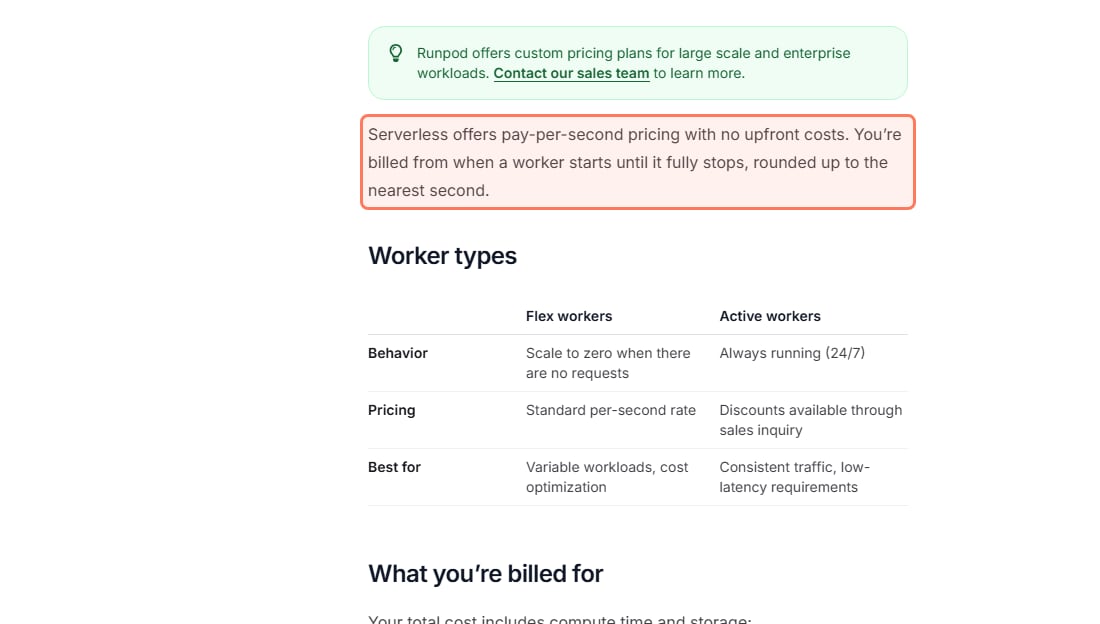
Compute while a worker runs, plus storage. Runpod's Serverless pricing docs say you're "billed from when a worker starts until it fully stops, rounded up to the nearest second", and list three billed phases.
Runpod's Serverless pricing docs (docs.runpod.io/serverless/pricing), read Nov 3, 2026. · Screenshot of docs.runpod.io by aliteq
What one Serverless request bills (Runpod docs, read Nov 3, 2026)
Image pull, cached model download
Normally done while the worker is scaled down, not billed
Cold start
Billed until your handler is ready, mostly loading the model into GPU memory
Execution
Billed while the job runs; the default execution timeout is 10 minutes
Idle timeout
Billed while the worker waits for the next request, 5 seconds by default
Scaled down
Shown as Idle in the console, not billed
Image pull, cached model download
Normally done while the worker is scaled down, not billed
Cold start
Billed until your handler is ready, mostly loading the model into GPU memory
Execution
Billed while the job runs; the default execution timeout is 10 minutes
Idle timeout
Billed while the worker waits for the next request, 5 seconds by default
Scaled down
Shown as Idle in the console, not billed
From Runpod's Serverless pricing and endpoint-configuration docs, read November 3, 2026.
Storage on top of compute, per Runpod's docs and pricing page (read November 3, 2026):
Container disk: about $0.10/GB a month, charged in 5-minute intervals.
Network volume (shared storage for model files): $0.07/GB a month under 1TB, $0.05/GB over 1TB; the high-performance tier is $0.14/GB a month.
What makes a Runpod Serverless bill bigger than you expect?
Five things, all from Runpod's own docs:
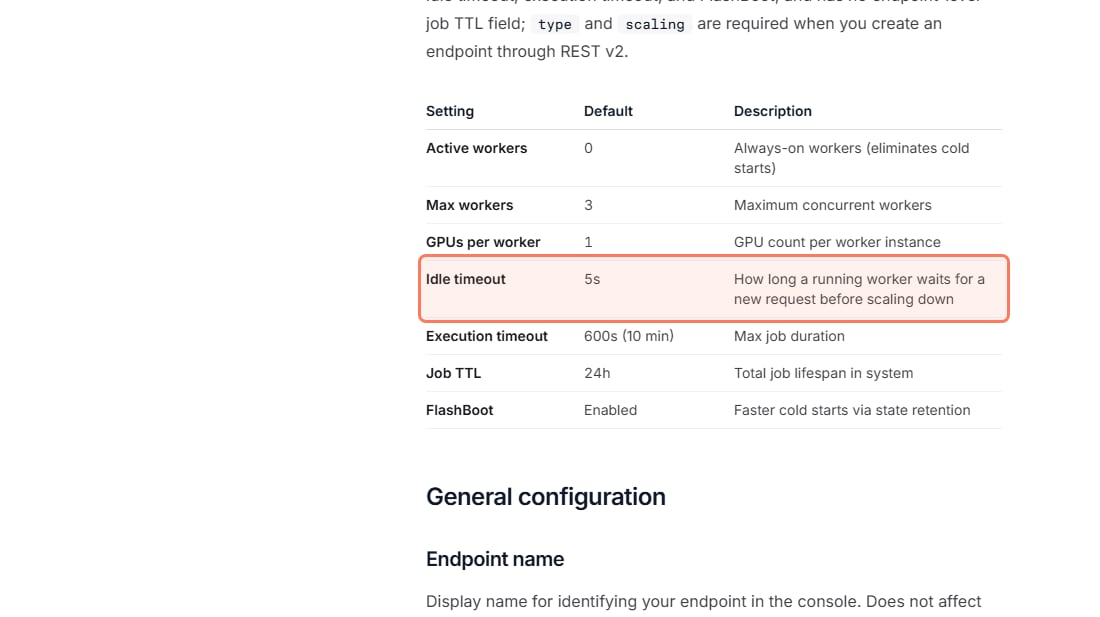
Runpod's endpoint defaults (docs.runpod.io), read Nov 3, 2026. The idle-timeout row is outlined. · Screenshot of docs.runpod.io by aliteq
A long idle timeout. The docs say a worker "is billed while it waits" for the next request. The console default is 5 seconds (10 seconds if you create the endpoint through REST v2). Raise it a lot to dodge cold starts and a scale-to-zero endpoint starts billing like an always-on one.
Active workers. Setting active workers to 1 or more removes cold starts, but the docs say "Active workers incur charges continuously, including when they have no jobs." Runpod's pricing docs list active-worker discounts as "available through sales inquiry", with no public rate, so price them at the flex rate unless sales quotes you lower.
Slow cold starts. You pay from the moment a worker starts until your handler is ready, which is mostly model loading. A big model that takes a minute to load bills that minute on every scale-up. Runpod says FlashBoot (on by default in the console, off by default through REST v2) and cached models shorten this. Runpod's Serverless page claims "sub-200ms FlashBoot cold starts"; that's Runpod's figure, we haven't measured it.
Runaway jobs. The console's default execution timeout is 600 seconds per job. Keep a timeout on so a stuck job can't bill for hours.
Rounding. Each worker's time is rounded up to the next second, so many tiny requests carry a little overhead each.
Two safety nets work in your favour: Runpod sets a default spend limit of $80 an hour across all resources, and an endpoint with no requests for 7 days has its max workers set to 0 (it's cut to 2 after 3 days, with an email). That second one can also surprise you: raise max workers again in the console before you use an old endpoint.
When should you rent a pod instead?
When the GPU is busy most of the day, or when the work isn't request-shaped:
Steady traffic above the break-even in the table above (for an H100, about 9 busy hours a day against a Community PCIe pod).
Training, fine-tuning and batch jobs that run for hours anyway. You'd pay the higher serverless rate for nothing.
Interactive work (a notebook, ComfyUI, testing models by hand), where a pod you start and stop yourself is simpler.
On the pod side, remember a stopped pod isn't free either: Runpod's pricing page lists volume disk at $0.10/GB a month while running and $0.20/GB a month while idle. For the pod decision, see the cheapest H100 rental, Runpod vs Vast vs Lambda and our Runpod review.
Frequently asked
How much does Runpod Serverless cost?
From $0.58 an hour for a 16GB worker up to $11.99 an hour for a B300, per Runpod's pricing page read November 3, 2026. A 24GB worker (L4, A5000, 3090) is $0.75, an A100 80GB is $2.72 and an H100 is $5.39. You pay that rate per second, only while a worker runs, plus storage.
Is Runpod Serverless more expensive than a pod?
Per hour, yes. A serverless H100 is $5.39 an hour against $1.99 (H100 PCIe, Community Cloud) to $3.99 (H100 SXM, Secure Cloud) for a pod, read November 3, 2026. Per month it's often far cheaper, because a pod bills every hour it's on and Serverless scales to zero. For an H100 it's cheaper below roughly 9 to 18 busy hours a day.
How is Runpod Serverless billed?
Per second, from when a worker starts until it fully stops, rounded up to the nearest second, per Runpod's docs. That includes the cold start (until your handler is ready) and the idle timeout while a worker waits for the next request, 5 seconds by default in the console. A worker that has scaled down, shown as Idle, is not billed.
Are cold starts billed on Runpod Serverless?
Yes, from the moment the worker starts until your handler is ready, which is mostly loading the model into GPU memory. Runpod's docs say pulling the container image and downloading cached models normally happen while the worker is scaled down and are not billed. FlashBoot and model caching shorten the billed part.
What is the difference between flex and active workers?
Flex workers scale to zero when there are no requests and pay the standard per-second rate. Active workers stay on 24/7, so there's no cold start, but they're billed continuously even with no jobs. Runpod's docs list active-worker discounts only through a sales inquiry, not as a public rate.
How much does storage cost on Runpod Serverless?
Container disk is about $0.10/GB a month, charged in 5-minute intervals. A network volume for shared model files is $0.07/GB a month under 1TB and $0.05/GB over 1TB, per Runpod's docs and pricing page read November 3, 2026.
The short version: Serverless is a bet that your GPU is idle most of the day. Count your real busy hours, check them against the break-even table, and see today's pod prices on our cloud-GPU compare page. For the bigger picture across providers, read the cloud-GPU pricing guide.