On Nov 3, 2026 a B200 rented for 1.4 to 2 times an H100 at the same managed cloud, and 3.6 times on Vast's marketplace. NVIDIA's own specs put it at about 2.3 times the compute and 2.25 times the memory. How to tell which side of that line your workload is on.
Some links on this page are referral links: we may earn a commission, at no cost to you.
Share
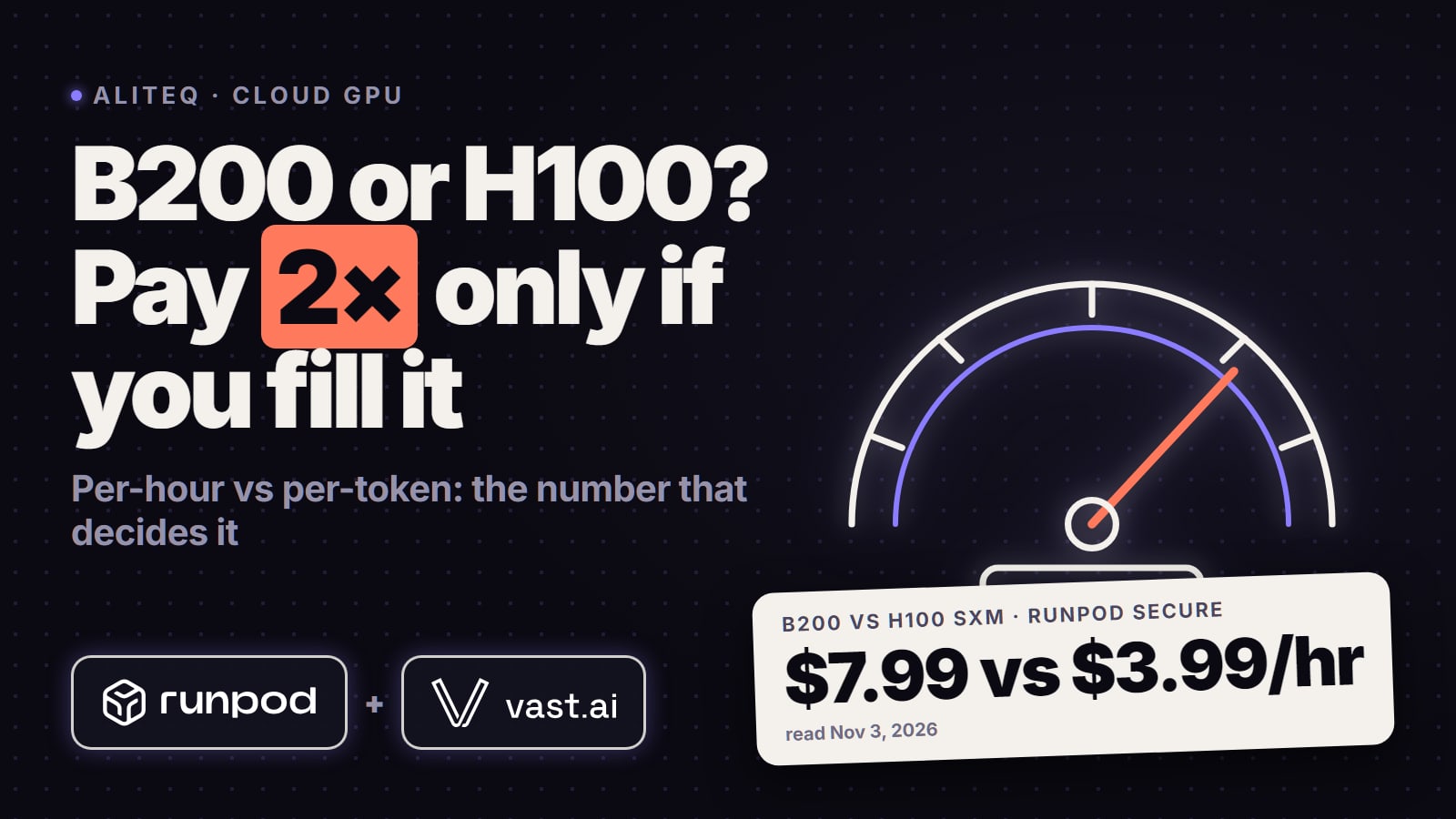
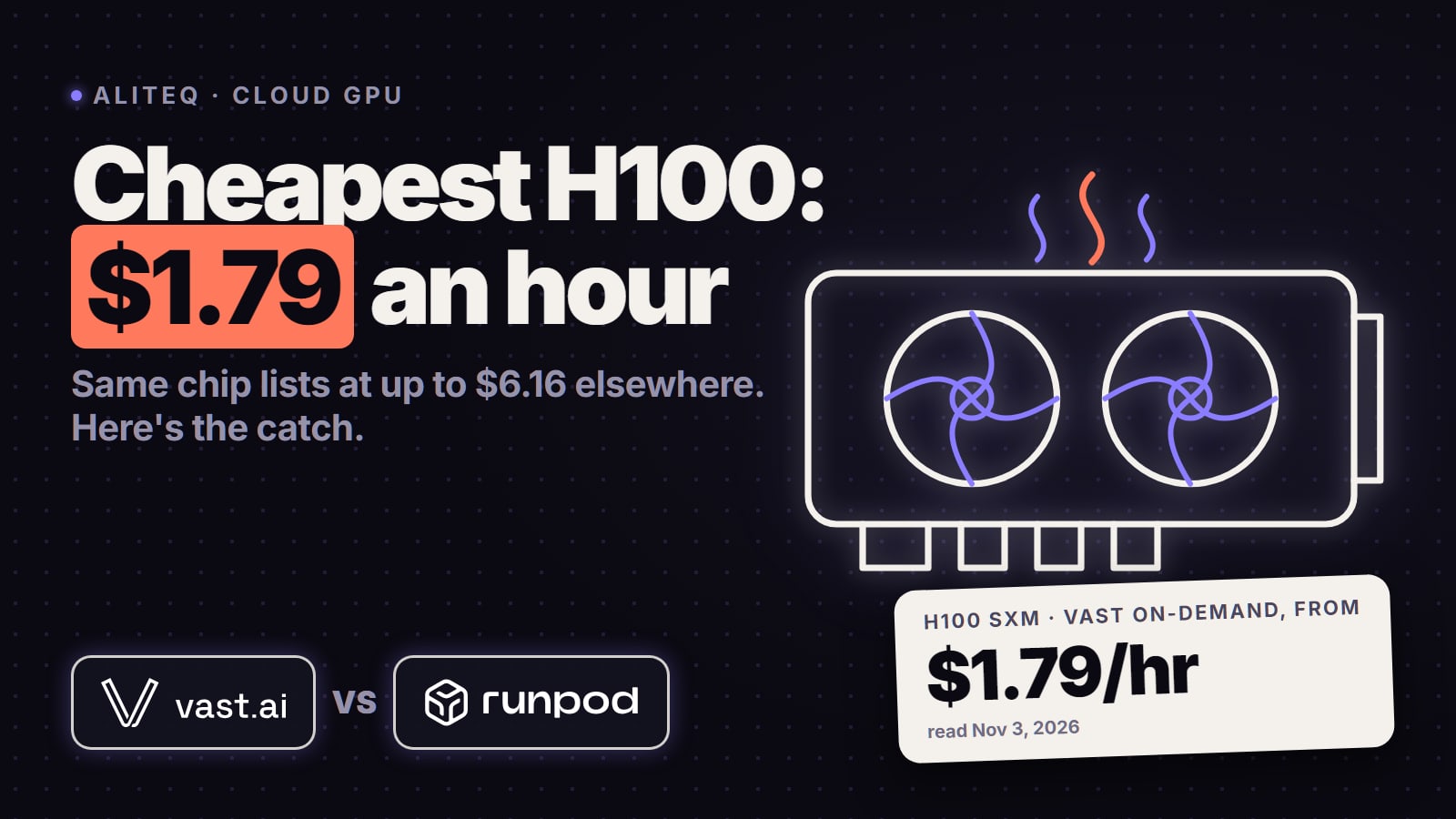
Is a B200 worth its rental premium over an H100? Only if it finishes your job faster than it costs more, or if your model doesn't fit in 80GB. On Nov 3, 2026 a B200 rented for $7.99 an hour on Runpod Secure Cloud against $3.99 for an H100 SXM, exactly 2× the price. At Lambda the gap was 1.6×, at Nebius 1.9× and at CoreWeave 1.4×. NVIDIA's own spec sheets put one B200 at about 2.3× an H100's FP8 compute, 2.4× its memory bandwidth and 2.25× its memory. So on paper a fully busy B200 is slightly cheaper per token at most managed clouds. In practice it only wins if your software really runs about twice as fast on it, and it loses outright for small models, idle time, and on Vast.ai's marketplace, where cheap H100s make the gap 3.6×. For today's prices, see our live cloud-GPU compare page.
What a B200 costs, in H100s, at the same provider (per GPU-hour, on-demand, read Nov 3, 2026)
CoreWeave (8-GPU HGX nodes)1.4×
$8.60 vs $6.16 per GPU
Lambda (1 GPU, SXM)1.6×
$6.99 vs $4.29
Hyperstack (H100 SXM)1.9×
$6.00 vs $3.20
Nebius (HGX)1.9×
$8.50 vs $4.50
Runpod Secure Cloud (H100 SXM)2.0×
$7.99 vs $3.99
Vast.ai marketplace (cheapest offers)3.6×
$8.75 vs $2.40; 2 and 3 offers
Below the price line, a B200 must do more than that many H100s' worth of work per hour to come out cheaper per token. NVIDIA's spec ratio is about 2.3×, so the margin is real at CoreWeave and Lambda, thin at Runpod and Nebius, and gone on Vast.
How much does a B200 cost to rent vs an H100?
About $6 to $9 an hour for a B200 and $2.40 to $6.16 for an H100, by provider, on Nov 3, 2026. The Vast and Runpod figures are from our hourly read of their APIs (20:20 UTC); every other price is the provider's own published on-demand rate, read the same day.
B200 vs H100 rental, $ per GPU-hour, on-demand (read Nov 3, 2026)
Hyperstack
Provider
$6.00
B200
$3.20 (SXM)
H100
Reserved B200 $5.10
Lambda (1 GPU)
Provider
$6.99
B200
$4.29 (SXM)
H100
B200 $6.69 per GPU on 8
Runpod Secure Cloud
Provider
$7.99
B200
$3.99 (SXM), $2.89 (PCIe)
H100
Community B200 $5.98
Nebius
Provider
$8.50
B200
$4.50
H100
Preemptible from $0.99 / $0.79
CoreWeave (8-GPU node)
Provider
$8.60
B200
$6.16
H100
$68.80 vs $49.24 a node
Vast.ai (cheapest offer)
Provider
$8.75
B200
$2.40 (SXM)
H100
Only 2 B200 and 3 H100 SXM offers
Provider
B200
H100
Note
Hyperstack
$6.00
$3.20 (SXM)
Reserved B200 $5.10
Lambda (1 GPU)
$6.99
$4.29 (SXM)
B200 $6.69 per GPU on 8
Runpod Secure Cloud
$7.99
$3.99 (SXM), $2.89 (PCIe)
Community B200 $5.98
Nebius
$8.50
$4.50
Preemptible from $0.99 / $0.79
CoreWeave (8-GPU node)
$8.60
$6.16
$68.80 vs $49.24 a node
Vast.ai (cheapest offer)
$8.75
$2.40 (SXM)
Only 2 B200 and 3 H100 SXM offers
Two things moved since our last read. Runpod's B200 used to be quoted at $5.98: that's still the Community Cloud price in its page's structured data, but the Secure Cloud price it lists is $7.99. And B200 supply on marketplaces is still thin: our Nov 3 read found two on-demand B200 offers on Vast, from $8.75, and interruptible ones from $7.50.
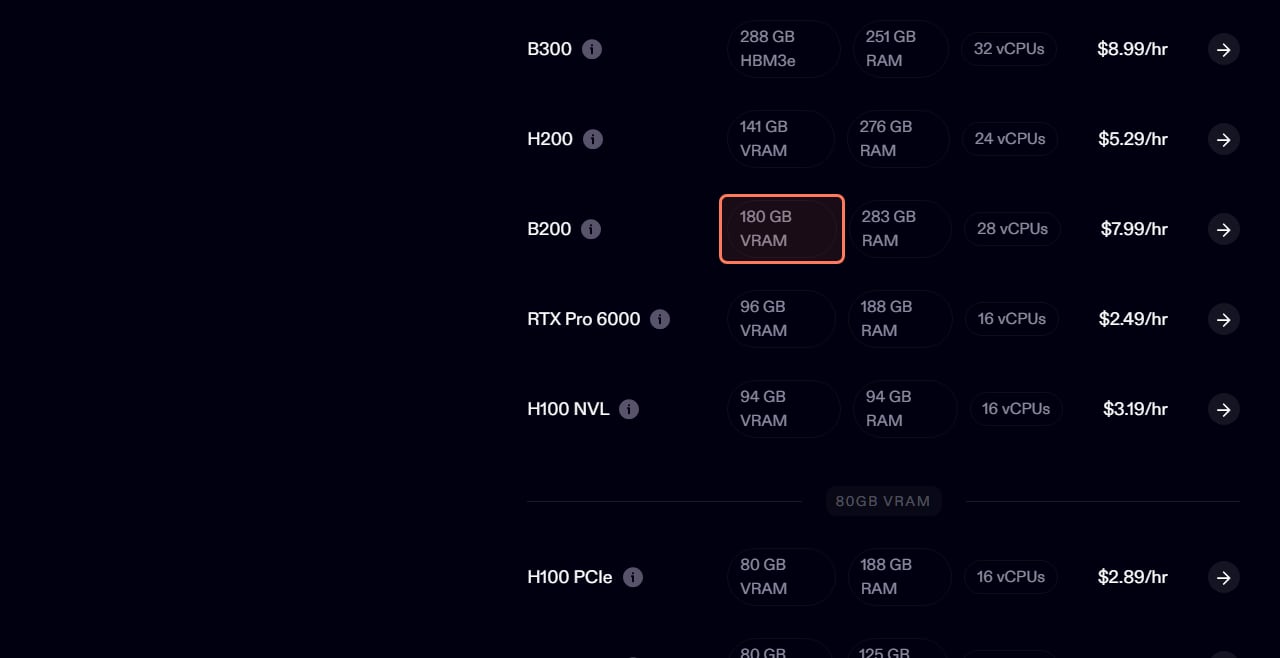
Runpod's own pricing page (runpod.io/pricing), read Nov 3, 2026: B200 with 180GB at $7.99 an hour, H100 PCIe at $2.89. H100 SXM, just below the crop, is $3.99. · Screenshot of runpod.io by aliteq
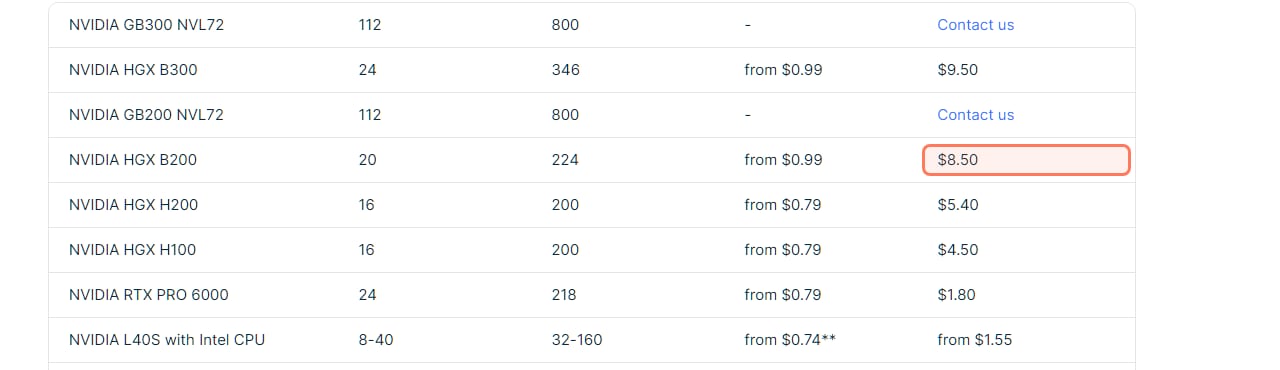
Nebius's own price table (nebius.com/prices), read Nov 3, 2026. Columns: vCPUs, RAM (GB), preemptible from, on-demand, all per GPU-hour. · Screenshot of nebius.com by aliteq
What does the B200's premium actually buy?
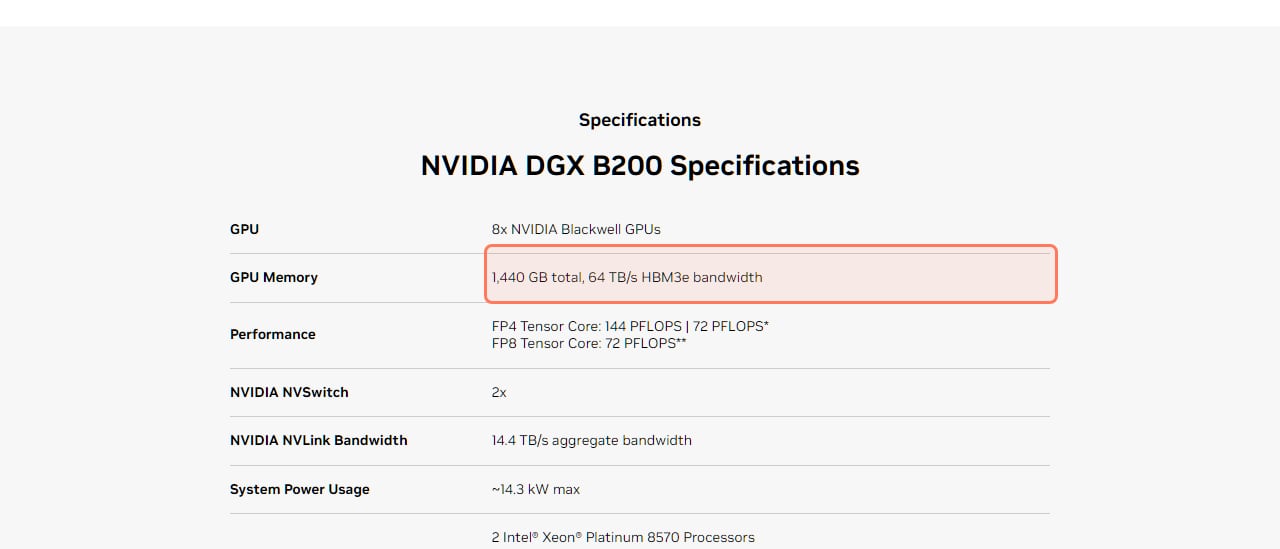
More memory, more bandwidth and more compute, by roughly the same factor. NVIDIA publishes the B200's figures for 8-GPU systems, so the per-GPU numbers below are those divided by eight.
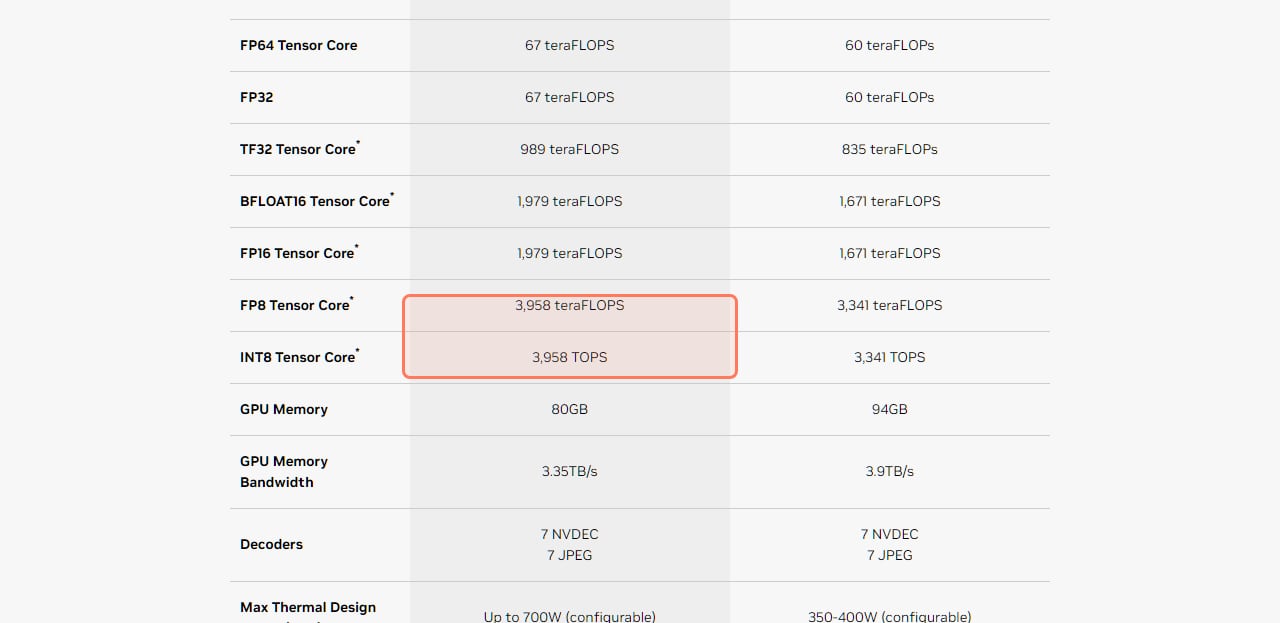
One B200 vs one H100 SXM, NVIDIA's own spec sheets (read Nov 3, 2026)
GPU memory
Spec
180GB HBM3e
B200 (per GPU)
80GB
H100 SXM
2.25×
Memory bandwidth
Spec
8 TB/s
B200 (per GPU)
3.35 TB/s
H100 SXM
2.4×
FP8 tensor (with sparsity)
Spec
9 petaFLOPS
B200 (per GPU)
3.96 petaFLOPS
H100 SXM
2.3×
BF16 tensor (with sparsity)
Spec
4.5 petaFLOPS
B200 (per GPU)
1.98 petaFLOPS
H100 SXM
2.3×
FP4 tensor
Spec
18 sparse, 9 dense petaFLOPS
B200 (per GPU)
Not listed
H100 SXM
New on Blackwell
Spec
B200 (per GPU)
H100 SXM
Ratio
GPU memory
180GB HBM3e
80GB
2.25×
Memory bandwidth
8 TB/s
3.35 TB/s
2.4×
FP8 tensor (with sparsity)
9 petaFLOPS
3.96 petaFLOPS
2.3×
BF16 tensor (with sparsity)
4.5 petaFLOPS
1.98 petaFLOPS
2.3×
FP4 tensor
18 sparse, 9 dense petaFLOPS
Not listed
New on Blackwell
Sources: NVIDIA's DGX B200 page lists "1,440 GB total, 64 TB/s HBM3e bandwidth" for 8 GPUs; its HGX page lists HGX B200 at 72 petaFLOPS FP8 and 36 BF16 (sparse) and 144 sparse / 72 dense FP4; its H100 page lists the SXM at 80GB, 3.35TB/s and 3,958 teraFLOPS FP8 "With sparsity". The ratios are our arithmetic. Rental providers list the B200 at 179 to 180GB, except Hyperstack, which lists 192GB.
NVIDIA's DGX B200 spec table (nvidia.com), read Nov 3, 2026: 1,440GB and 64 TB/s across 8 GPUs, so 180GB and 8 TB/s each. · Screenshot of nvidia.com by aliteq
NVIDIA's H100 spec table (nvidia.com/en-us/data-center/h100), read Nov 3, 2026. Left column H100 SXM, right H100 NVL; tensor figures are with sparsity. · Screenshot of nvidia.com by aliteq
What about NVIDIA's "15X the inference performance of DGX H100"? It's on the DGX B200 page, and its footnote says "Projected performance subject to change", measured per GPU at a 32,768-token input with a 50ms token-to-token latency target. The same page's cost claim, Blackwell "roughly 4.5x cheaper" per token than Hopper, compares TensorRT-LLM on Blackwell with vLLM on Hopper on one model (GPT-OSS-120B). Those are best-case setups chosen by the seller. Plan with the spec ratios, then measure your own job.
When is a B200 cheaper per token than an H100?
When it runs your job faster than its price ratio. The rule is one line of arithmetic: cost per token = price per hour ÷ tokens per hour. At Runpod Secure Cloud ($7.99 vs $3.99), a B200 that does 2.5× the H100's tokens costs 20% less per token; one that does 1.5× costs 33% more. At Lambda's 1.6× ratio, the B200 only has to be 1.6× faster to break even.
Whether your job gets that speedup depends on three things:
Is the card busy? Per-token math only counts the minutes it's generating. A pod you leave open while you read logs is billed by the hour, and a B200's idle hour costs double an H100's. For one person testing prompts, idle time usually decides it, and the H100 wins.
Is the job big enough? Large models and large batches stretch the B200's bandwidth and compute; a small model at batch size 1 can't use them, so the speedup lands well below 2×. On a 7B or 8B model, both cards are overkill: an H100 already is, and a cheaper 24GB card usually is too.
Does your software use Blackwell? Support is newer. PyTorch added Blackwell support in version 2.7 (released 2025) as a prototype feature, with pre-built CUDA 12.8 wheels, and the B200's FP4 speed needs a model and serving stack that run in FP4. An image built for an H100 on an older CUDA may not run on a B200 at all, or may run without the new paths. Check your container's CUDA and framework versions before you rent.
The cheapest way to know: rent each card for an hour, run the same job, and divide the price by the work done. On Runpod Secure Cloud that test costs about $12 ($7.99 + $3.99), by our arithmetic.
When does a B200 win outright?
When your model doesn't fit in 80GB. Then the comparison isn't one B200 against one H100, it's one B200 against two or three H100s. A rough rule: at 8-bit precision each billion parameters takes about 1GB for the weights, plus room for the context (KV cache). A model of around 100 to 150 billion parameters at 8-bit needs more than one H100 but can fit on a single B200's 180GB; use our VRAM calculator for your exact model and context length.
Runpod Secure Cloud: two H100 SXMs cost $7.98 an hour, one B200 $7.99. Same price, but the B200 keeps the model on one card with no splitting between GPUs.
Lambda: two H100 SXMs cost $8.38 an hour ($4.19 each on its 2x plan), one B200 $6.99. The B200 is cheaper.
Three H100s (for models that need more than 160GB) cost more than one B200 at every managed provider in our table. Only on Vast's marketplace were three of the cheapest H100 offers ($7.20 together) under its cheapest B200 ($8.75), and it had just three H100 SXM offers that day.
Splitting a model across GPUs works, but it adds setup, and traffic between cards slows each token. See multi-GPU setups for how that trade-off works.
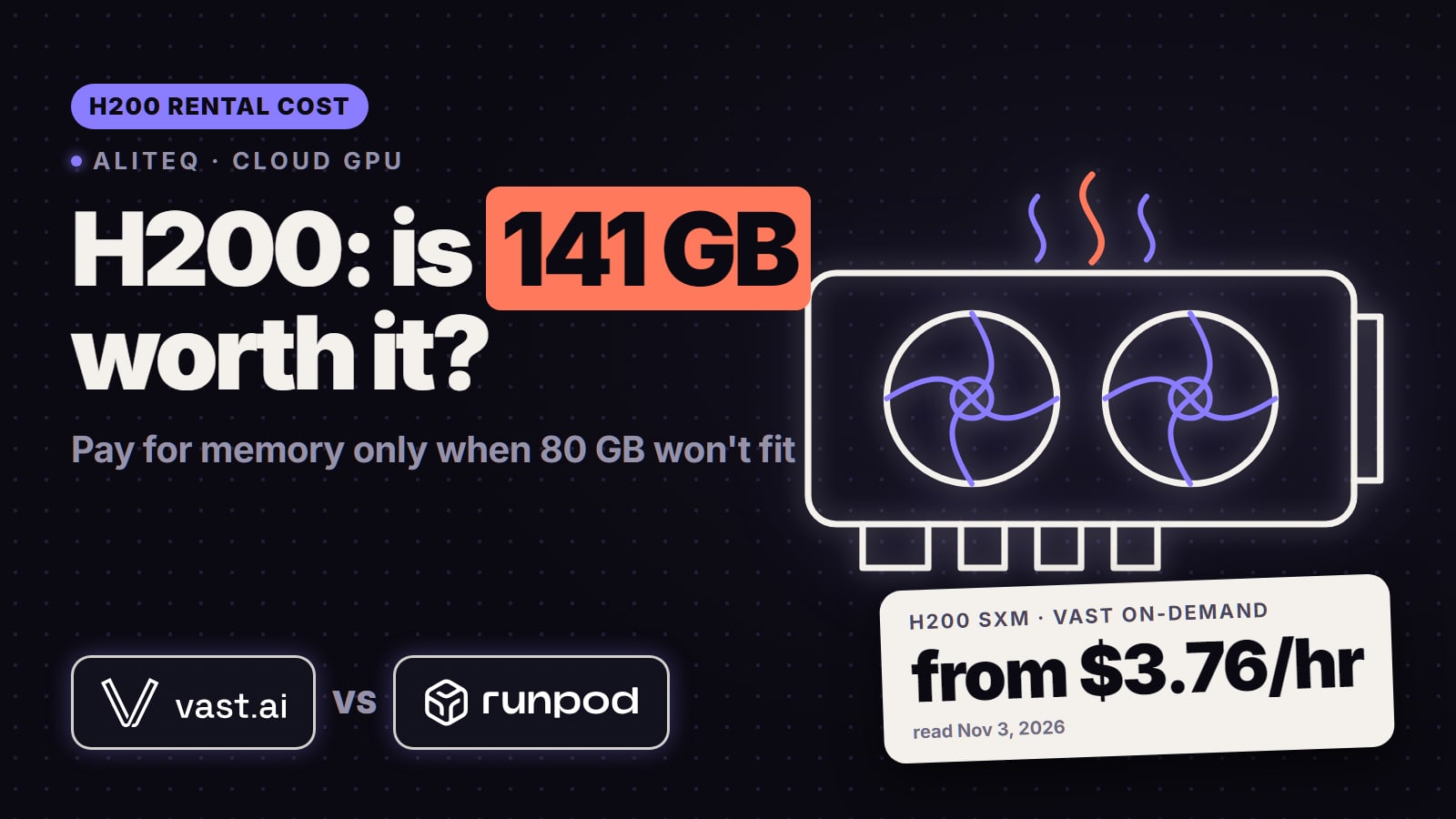
One more option on the same page: Runpod listed a B300 with 288GB at $8.99 an hour on Nov 3, 2026, $1 more than its B200. On Vast our same read had one on-demand B300 offer at $7.89, below its cheapest B200. If you're renting for memory, compare that too.
Is a B200 worth it for fine-tuning or training?
For a big run that keeps it busy for hours, often yes; for a small LoRA, no. Training is the workload that keeps a GPU fully fed, so the per-token logic applies cleanly: if your run finishes in less than half the time on a B200 at Runpod's 2× price, it's cheaper overall, and the 180GB lets you use bigger batches or skip some memory-saving tricks. A two-hour QLoRA fine-tune of an 8B model, by contrast, fits comfortably on one H100 or smaller, and the B200's extra speed saves you minutes at double the hourly rate. Our guide to the best cloud GPU for fine-tuning matches card to job size.
For multi-GPU training, CoreWeave's 8-GPU B200 node ($68.80 an hour) costs 1.4× its H100 node ($49.24), the smallest ratio in our table, because both are premium data center nodes. That's the setting where NVIDIA's speedups are most likely to show up.
Frequently asked
Is a B200 worth renting over an H100?
Only in two cases: your model or batch needs more than 80GB, or your job runs on the B200 faster than its price ratio and you keep it busy. On Nov 3, 2026 a B200 cost 2.0× an H100 SXM on Runpod Secure Cloud ($7.99 vs $3.99), 1.6× on Lambda and 1.4× on CoreWeave. NVIDIA's specs give the B200 about 2.3× the compute, so a fully busy B200 can be slightly cheaper per token; for small models or light use, the H100 is cheaper.
How much does it cost to rent a B200?
On Nov 3, 2026, on-demand B200s were $6.00 an hour on Hyperstack, $6.99 on Lambda (1 GPU), $7.99 on Runpod Secure Cloud, $8.50 on Nebius, $8.60 per GPU on CoreWeave's 8-GPU node and from $8.75 on Vast.ai's marketplace. Runpod's Community Cloud price was $5.98 and Hyperstack's reserved price $5.10. Check a live index before you rent.
How much faster is a B200 than an H100?
On NVIDIA's spec sheets, about 2.3× in FP8 and BF16 tensor compute and 2.4× in memory bandwidth (8 TB/s vs 3.35 TB/s), with 180GB of memory against 80GB. Real speedups depend on model size, batch size and software; small models at low batch sizes gain much less. NVIDIA's larger claims, like 15× inference, are projected best cases under specific settings.
Why does Runpod show a B200 for $5.98?
That's the Community Cloud price in Runpod's pricing data. The Secure Cloud price Runpod lists on its page was $7.99 an hour on Nov 3, 2026. Runpod's B200 serverless rate is higher, $10.79 an hour.
Is one B200 cheaper than two H100s?
Often, if your model needs both H100s. On Nov 3, 2026 one B200 cost $7.99 an hour on Runpod Secure Cloud against $7.98 for two H100 SXMs, and $6.99 on Lambda against $8.38 for two H100 SXMs. The B200 also keeps the model on one card, which avoids the overhead of splitting it.
Does my code run on a B200?
Only with Blackwell-ready software. PyTorch added Blackwell support in version 2.7 with CUDA 12.8 builds, so an older container built for H100 may need updating. FP4 speed also needs a model and serving stack that run in FP4. Check your CUDA and framework versions before renting.
Is an H100 or a B200 better for fine-tuning?
For a small LoRA or QLoRA fine-tune, an H100 or a smaller card is cheaper; the B200 saves minutes at double the hourly price. For a long training run that keeps the GPU fully busy, a B200 that finishes in less than half the time is cheaper overall at Runpod's 2× price ratio, and less than 1.6× the time at Lambda's.