Yes, on all four. TikTok Shop, TikTok ads, Meta and YouTube allow AI video, but each one labels it differently, and TikTok Shop bans AI that changes or fakes the product. We read every rule on the platforms' own pages on November 18, 2026.
Some links on this page are referral links: we may earn a commission, at no cost to you.
Share
Yes, you can use AI video in TikTok Shop videos, TikTok ads, Facebook and Instagram ads and YouTube, but not to fake the product. All four platforms allow AI-made video. TikTok asks you to label realistic AI yourself and rejects undisclosed AI ads. Meta labels AI ads "AI info" on its own. YouTube wants realistic AI disclosed at upload. TikTok Shop is the strictest: AI must never change, replace or exaggerate the product, and since October 19, 2026 Beauty, Personal Care and Health videos may not use AI to show the product working. We read every rule below on the platforms' own pages on November 18, 2026.
What does each platform allow, label and ban?
Here is the whole picture in one table. The rows that matter most for sellers are the first two: TikTok Shop has its own commerce rules on top of TikTok's general ones.
AI video rules by platform (each platform's own pages, read Nov 18, 2026)
TikTok Shop videos (sellers and affiliate creators)
AI video allowed?
Yes, if accurate and not misleading
Label needed when
Fully or significantly AI-generated or edited content; synthetic faces, voices, digital humans
Banned or rejected
AI that changes size, color, material, quantity or features; fake effects; animating static products; fake experts; impersonation. Beauty, Personal Care and Health may not use AI to show core effects (from Oct 19, 2026)
How the label is applied
"AI-generated content" toggle, or on-screen text, watermark, sticker or description note; auto-label from metadata
Source
TikTok Shop Academy AIGC page (updated Sep 2, 2026) and Policy Pulse (updated Nov 5, 2026)
TikTok Shop LIVEs
AI video allowed?
AI-made scenes are not the issue; the format is
Label needed when
Same as videos
Banned or rejected
AI-generated voices, audio recordings or radio; stills, slideshows or animated content over 50% of the screen; product page screenshots
How the label is applied
Same as videos
Source
Requirements for High-Quality Videos and LIVEs (updated Nov 6, 2026)
TikTok ads (Ads Manager, non-Spark)
AI video allowed?
Yes, with a disclosure
Label needed when
Completely AI-generated media; a subject shown doing or saying what they didn't, including AI voice cloning
Banned or rejected
Undisclosed AI (rejected or restricted); public figures in false endorsements; misleading before-and-after effect comparisons
How the label is applied
Toggle "This ad contains AI-generated content" at ad creation, or your own disclaimer, caption, watermark or sticker
Source
TikTok ad policy, Misleading and false content (updated November 2026); Add disclaimers to ads (updated September 2025)
TikTok organic and Spark ads
AI video allowed?
Yes
Label needed when
Realistic AI images, audio and video
Banned or rejected
AI showing public figures endorsing; minors' likeness; private people without permission
How the label is applied
"AI-generated content" setting in post options; TikTok auto-labels C2PA Content Credentials and TikTok AI effects
Source
TikTok Help, About AI-generated content; Community Guidelines (effective Sep 24, 2026)
Meta ads (Facebook and Instagram)
AI video allowed?
Yes
Label needed when
Meta applies the label itself to ads made or significantly edited with its AI tools or third-party AI tools. Political and social issue ads must self-disclose photorealistic AI
Banned or rejected
Undisclosed AI in political or social issue ads (rejected); celebrity-bait scams; altered media with high risk of deceiving the public on a matter of public importance (may be rejected)
How the label is applied
"AI info" label in "About this ad", sometimes next to "Sponsored"; detection through industry-standard signals
Source
Meta Help Center (updated a day before our read); Meta Newsroom (updated Jun 1, 2026); Meta Transparency Center
Meta organic posts and Reels
AI video allowed?
Yes
Label needed when
Photorealistic video or realistic-sounding audio that was digitally created or altered
Banned or rejected
Penalties possible if you don't disclose
How the label is applied
Meta's AI-disclosure tool when posting
Source
Meta Community Standards, Misinformation
YouTube (including Shorts)
AI video allowed?
Yes
Label needed when
A real person saying or doing what they didn't, altered real events or places, realistic scenes that didn't happen, AI music as the main focus
Banned or rejected
Consistent non-disclosure can lead to removal or YouTube Partner Program suspension
How the label is applied
"AI use" setting in YouTube Studio; auto-label for C2PA metadata, which can't be adjusted
Source
YouTube Help, Disclosing use of GenAI content
AI video allowed?
Label needed when
Banned or rejected
How the label is applied
Source
TikTok Shop videos (sellers and affiliate creators)
Yes, if accurate and not misleading
Fully or significantly AI-generated or edited content; synthetic faces, voices, digital humans
AI that changes size, color, material, quantity or features; fake effects; animating static products; fake experts; impersonation. Beauty, Personal Care and Health may not use AI to show core effects (from Oct 19, 2026)
"AI-generated content" toggle, or on-screen text, watermark, sticker or description note; auto-label from metadata
TikTok Shop Academy AIGC page (updated Sep 2, 2026) and Policy Pulse (updated Nov 5, 2026)
TikTok Shop LIVEs
AI-made scenes are not the issue; the format is
Same as videos
AI-generated voices, audio recordings or radio; stills, slideshows or animated content over 50% of the screen; product page screenshots
Same as videos
Requirements for High-Quality Videos and LIVEs (updated Nov 6, 2026)
TikTok ads (Ads Manager, non-Spark)
Yes, with a disclosure
Completely AI-generated media; a subject shown doing or saying what they didn't, including AI voice cloning
Undisclosed AI (rejected or restricted); public figures in false endorsements; misleading before-and-after effect comparisons
Toggle "This ad contains AI-generated content" at ad creation, or your own disclaimer, caption, watermark or sticker
TikTok ad policy, Misleading and false content (updated November 2026); Add disclaimers to ads (updated September 2025)
TikTok organic and Spark ads
Yes
Realistic AI images, audio and video
AI showing public figures endorsing; minors' likeness; private people without permission
"AI-generated content" setting in post options; TikTok auto-labels C2PA Content Credentials and TikTok AI effects
TikTok Help, About AI-generated content; Community Guidelines (effective Sep 24, 2026)
Meta ads (Facebook and Instagram)
Yes
Meta applies the label itself to ads made or significantly edited with its AI tools or third-party AI tools. Political and social issue ads must self-disclose photorealistic AI
Undisclosed AI in political or social issue ads (rejected); celebrity-bait scams; altered media with high risk of deceiving the public on a matter of public importance (may be rejected)
"AI info" label in "About this ad", sometimes next to "Sponsored"; detection through industry-standard signals
Meta Help Center (updated a day before our read); Meta Newsroom (updated Jun 1, 2026); Meta Transparency Center
Meta organic posts and Reels
Yes
Photorealistic video or realistic-sounding audio that was digitally created or altered
Penalties possible if you don't disclose
Meta's AI-disclosure tool when posting
Meta Community Standards, Misinformation
YouTube (including Shorts)
Yes
A real person saying or doing what they didn't, altered real events or places, realistic scenes that didn't happen, AI music as the main focus
Consistent non-disclosure can lead to removal or YouTube Partner Program suspension
"AI use" setting in YouTube Studio; auto-label for C2PA metadata, which can't be adjusted
YouTube Help, Disclosing use of GenAI content
What does TikTok Shop allow, and what gets removed?
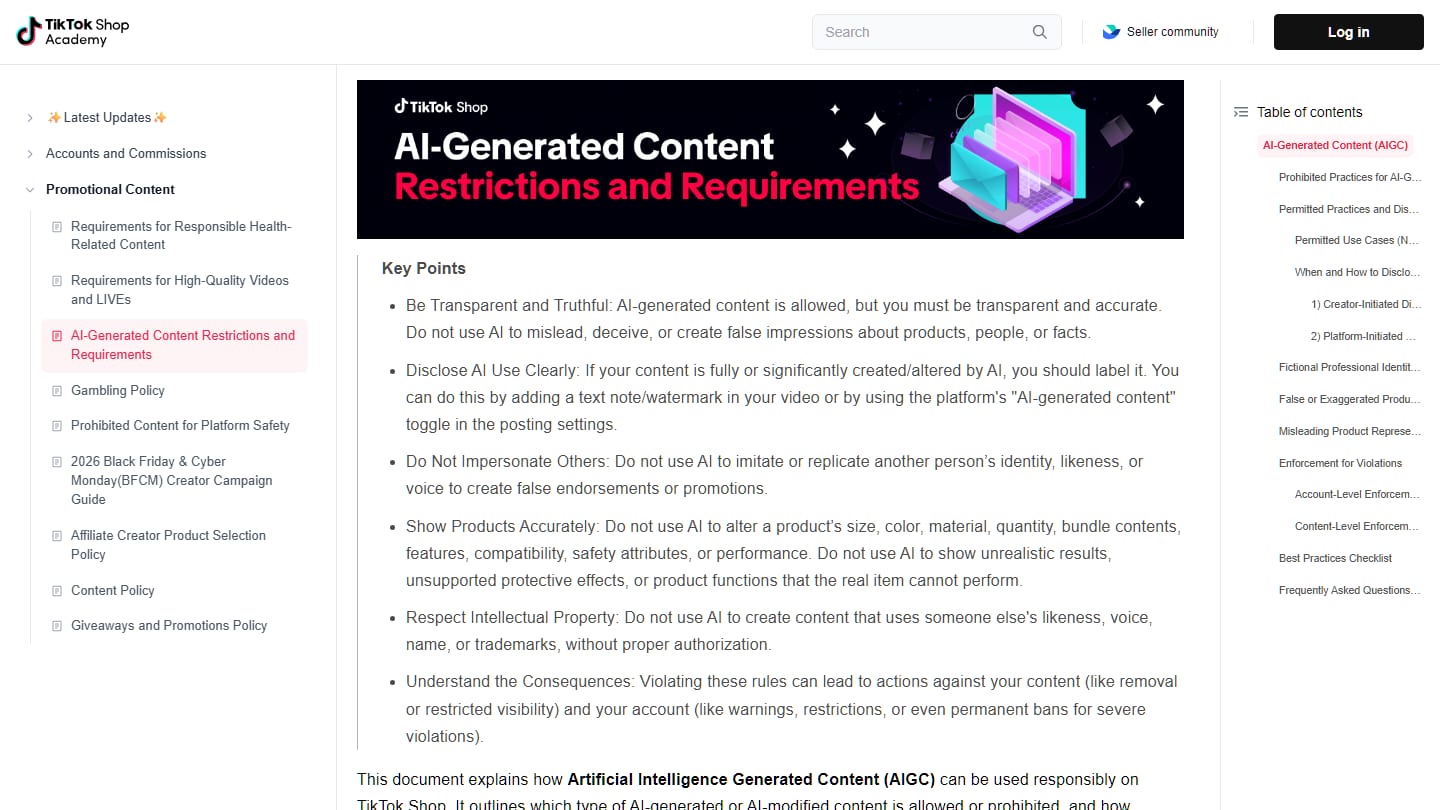
TikTok Shop allows AI, as long as the product on screen is the product the buyer gets. Its US Academy page on AI content, updated September 2, 2026, opens with "AI-generated content is allowed, but you must be transparent and accurate." It also says content "will not be restricted or penalized solely for using AI."
What TikTok Shop lists as permitted
The page gives five permitted uses, as long as the product information stays true:
Visual styles and effects, such as turning live footage into cartoon or anime styles.
Editing, including better lighting and colors and changed backgrounds, "as long as the product information is not altered."
Translation, dubbing and subtitles, including AI narration in other languages.
Copywriting and scripts for titles, descriptions and video scripts.
Product demonstrations with virtual scenes or animations, if they reflect the real size, material, functions and normal results.
That third point matters for anyone choosing a tool with AI voices. In a recorded Shop video, AI dubbing and narration are on the permitted list.
What TikTok Shop bans, even with a label
The hard line is product truth. TikTok says product promotion videos "must clearly and accurately display the physical product," and AI "must not be used to replace or fabricate product displays." The page names these as not allowed:
Changing the product. No AI that alters size, color, material, shape, quantity, bundle contents, features or compatibility.
Fake effects. No AI showing a product "faster, stronger, or more effective than it really is." TikTok's examples include shampoo that instantly grows hair and a vacuum removing deep stains instantly.
Compressed before-and-after. Before-and-after visuals "must not compress time or imply instant results" unless evidence supports it.
Fake 3D and fake motion. No turning flat products into fake 3D or rotating visuals, and no animating static products in unrealistic ways.
Fake experts. No AI "doctors" or "professors" endorsing health products, and no AI digital humans dressed up as news or expert lectures.
Impersonation. No AI copying another person's identity, likeness or voice "to create false endorsements or promotions."
A separate Academy page, updated September 24, 2026, applies the same rules to AI product listing images. It says AIGC "is allowed when it accurately represents the real product." It also bans AI that makes an item look bigger than its stated size, and AI that swaps the product for a real animal, such as real kittens in a cat toy listing.
The new Beauty, Personal Care and Health rule
This is the rule most likely to catch a skincare or supplement brand. TikTok Shop's October 2026 Policy Pulse says that starting October 19, 2026, short videos in Beauty & Personal Care and Health "may not use AIGC to demonstrate core product effects or product-use imagery."
Its examples: AI humans or AI hands showing a product working, AI-generated experts or medical professionals endorsing products, and AI showing a product used on the body, such as applying skincare or taking supplements. If you sell in those categories, film the product in use with a real person. Our AI product photos and ads for skincare brands guide covers where AI still fits around that footage.
Are AI voices and still images banned on TikTok Shop?
In LIVEs, yes. In recorded videos, not as such. Some trade coverage in mid-2026 said the ban covered "promotional livestreams and shoppable videos" alike. TikTok's own page, updated November 6, 2026, is narrower. During a LIVE, it bans "non-real-time verbal interaction such as AI-generated voices, audio recordings, or radio," and still or animated content covering more than half the screen.
For recorded videos, the rule is about effort, not AI. TikTok says not to use "still, looping, or scrolling images through the entire video" without featuring your face and the physical product. It asks you to "aim for at least 3 seconds of dynamic content" with no stills. Its list of still frame content includes slideshows, screen recordings and "animated content" with little movement. So a slideshow of AI product stills over an AI voice is risky. A real person holding the real product, with AI used for the B-roll, is not.
What happens if you break the rules?
TikTok lists steps that grow with severity. For a video, it may limit distribution, remove product links or the shopping cart, or deduct Creator Health Rating points. For an account, it runs from a warning to posting limits and losing commission withdrawal, up to a ban. It also counts a missing label as a violation: "Failing to disclose AI use when AI plays a significant role" can lead to removal or account restrictions.
When do TikTok ads need the AI disclaimer?
You need it when the ad is completely AI-generated or significantly changed by AI. TikTok's ad policy on misleading and false content, updated November 2026, defines "significantly modified" with three examples: fully AI-made images, video or audio; the main subject shown doing something they didn't do; and the subject saying something they didn't say, "using AI voice-cloning."
Minor AI edits don't count. TikTok lists lighting, brightness or color changes, removing or changing backgrounds, and denoising. If you're unsure, the policy says "it's best to use caution and label it accordingly." The consequence is plain: "If we identify AI-generated content that has not been disclosed, your ad will be rejected or restricted."
How to apply it, from TikTok's "Add disclaimers to ads" page:
Check the ad type. The toggle is for in-feed TikTok ads that are not Spark ads. Spark ads run as organic posts, so they follow the organic labeling rules.
Turn it on at ad creation. In TikTok Ads Manager, check the toggle "This ad contains AI-generated content."
Re-check every new campaign. TikTok says new campaigns, duplicates included, reset the toggle even when you reuse the same ad. After you submit, it can't be switched off unless you change the creative.
The same ad policy also bans two things a label won't fix: public figures in a "false endorsement" without permission, and before-and-after effect comparisons that give a "false or distorted impression" of results. That second rule applies to ads whether AI made them or not.
Will Facebook and Instagram label or reject an AI ad?
Meta labels AI ads; it doesn't reject ordinary commercial ads for being AI. Meta's Help Center says ads "created or significantly edited" with Meta's generative AI features, or created or edited with third-party AI tools, get an "AI info" label. It shows on the "About this ad" screen in the ad's menu, and "sometimes" next to the Sponsored label. Minor changes such as image resizing or color correction don't trigger it.
For outside tools, Meta's newsroom post, updated June 1, 2026, says Meta will detect ads made with "third-party AI tools through industry-standard signals." Our reading: if your tool writes provenance metadata into the file, expect the label, whether or not you mention AI. The Meta pages we read don't ask commercial advertisers to self-disclose AI. They only require it for political ads.
Three Meta rules can still get an AI ad rejected:
Political and social issue ads. Advertisers must disclose photorealistic images, video or realistic audio made with generative AI that depict things such as a real person saying what they never said. Meta says it "will reject the ad" if you don't.
High-risk altered media. Meta's Misinformation standard says it may "reject content submitted as an advertisement" when realistic altered media risks deceiving the public on a matter of public importance.
Celebrity-bait. Meta's Prohibited Commercial Practices standard bans falsely using a public figure's "name, likeness, or imagery" to lure people into a scam.
If you post the same AI video organically as a Reel or post, the rule flips. Meta's Community Standards require you to use its AI-disclosure tool for organic "photorealistic video or realistic-sounding audio" that was digitally created or altered, and say Meta "may apply penalties" if you don't.
Meta's own pages don't say whether the "AI info" label lowers ad results, and we found no solid public data on it. Store owners' reports on that question are in what works and what flops in AI ads for Shopify stores.
What do you have to disclose on YouTube?
YouTube asks for disclosure when AI content "seems realistic." Its Help page lists four cases: a real person shown saying or doing what they didn't, altered footage of a real event or place, a realistic scene that never happened, and AI music that is the main focus. You tick "Yes" under "AI use" in YouTube Studio when you upload.
YouTube says disclosure "won't limit a video's audience or impact its eligibility to earn money." It also auto-labels content that carries C2PA metadata, and that label can't be adjusted. Creators who "consistently choose not to disclose" risk removal or YouTube Partner Program suspension. The full breakdown, with YouTube's examples, is in what YouTube's altered or synthetic content label means. These are YouTube's upload rules; we didn't review Google Ads policy for paid YouTube ads on this page.
Can an AI avatar pose as a happy customer?
No, not on any platform, and not under US law. TikTok Shop bans AI that creates "false endorsements or promotions" and invented professional personas. The FTC's final rule from August 14, 2024 covers testimonials that claim to be from "someone who does not exist, such as AI-generated fake reviews." An AI actor can show and describe your product in an ad. It can't claim an experience no customer had.
A checklist for an AI product ad before you upload
Run this on every AI ad or Shop video. Each line maps to a rule above.
Compare against the listing. Size, color, material, count and included parts must match the product page and what ships. Check every frame, not just the first.
Kill fake results. No instant before-and-after, no glow or motion the product doesn't have, no flat item made to look 3D.
Check your category. Beauty, Personal Care or Health on TikTok Shop: no AI hands, faces or bodies showing the product working (since Oct 19, 2026).
No borrowed faces or voices. No public figures, no real people without written permission, no AI doctors or experts, no fake customer stories.
Show the real thing. For TikTok Shop videos, feature a real person and the physical product, with movement, not a slideshow of stills.
Label it. TikTok ads: the AI toggle on each new campaign. TikTok Shop and organic posts: the AI-generated content setting. YouTube: AI use set to Yes. Meta ads: expect the AI info label.
Keep proof. Save the source product photos and any test results behind a claim, in case TikTok asks for evidence.
How do these rules change the AI video tool you pick?
They push you toward tools that start from your real product, and away from anything that promises to dodge labels.
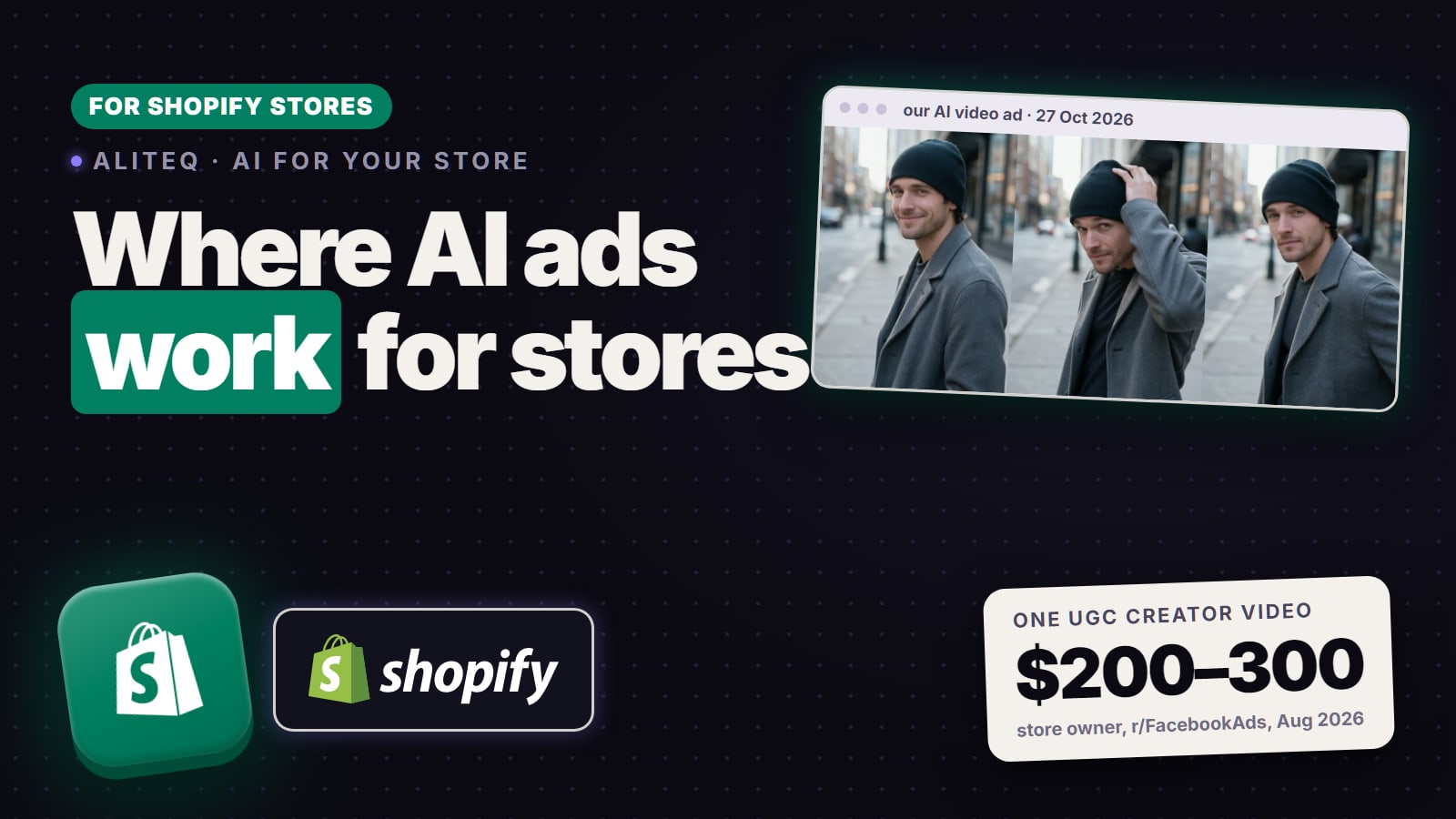
Image-to-video from your own photo. TikTok Shop's core rule is that the product can't change. Tools that animate a product photo you already checked beat text-to-video prompts, which invent details. In our one phone photo test, one AI model added a cuff to a plain beanie in five of twelve shots. That's a "product not as described" problem on TikTok Shop.
C2PA Content Credentials. Some AI tools write a signed record of how a file was made. TikTok and YouTube say they auto-label files with C2PA metadata, and neither lets you remove that label. Meta says it detects third-party AI through industry-standard signals. We didn't check which tools write C2PA today. You can test your own export with the free Content Credentials verify tool. Stripping the metadata doesn't remove the duty to disclose: TikTok Shop says that if no label is applied automatically, you still have to self-disclose.
AI voice features. AI narration and dubbing are fine in recorded TikTok Shop videos and must be real-time speech in LIVEs. Cloning someone else's voice without permission is out everywhere. On YouTube, cloning your own voice for a voiceover is on the list of things you don't have to disclose.
Avatars. An AI presenter is allowed with a label. An AI presenter posing as a customer, a doctor or a celebrity is not.
The research we started from used secondary sources, so we checked each claim on the platforms' own pages. These didn't hold up as stated:
"TikTok Shop banned AI voices in shoppable videos." TikTok's own page bans AI voices in LIVEs. For recorded videos, its AI page lists AI dubbing and narration as permitted.
"Every TikTok Shop video needs at least 3 seconds of dynamic content." TikTok's wording is softer: "Aim for at least 3 seconds." The firm rule is no stills through the whole video without your face and the product.
Strike counts. One seller blog says three policy strikes in 90 days close a shop. We found no such number on TikTok's AI or video pages, so we left it out.
Meta's label placement for photorealistic people. Meta's 2025 post says AI-made photorealistic humans get the label next to Sponsored. That line is about Meta's own AI tools. For third-party tools, Meta's current Help page says only that the label sometimes appears there.
Quick answers
Can you use AI videos on TikTok Shop?
Yes. TikTok Shop's policy says AI-generated content is allowed if it is transparent and accurate. AI can't change, replace or exaggerate the product, fake results, or impersonate people, and fully or significantly AI-made content should be labeled.
Are AI voices banned on TikTok Shop?
In LIVEs, yes. TikTok Shop bans AI-generated voices and pre-recorded audio in LIVEs. For recorded videos, its AI policy lists AI translation, dubbing and narration as permitted uses, as long as the content is accurate.
Can beauty and supplement brands use AI videos on TikTok Shop?
Not to show the product working. Since October 19, 2026, short videos in Beauty and Personal Care and Health may not use AI to demonstrate core product effects, show AI hands or people using the product on the body, or show AI experts endorsing it.
Do I have to label AI ads on TikTok?
Yes, if the ad is completely AI-generated or significantly modified by AI. Use the "This ad contains AI-generated content" toggle in Ads Manager or your own clear disclaimer. TikTok says undisclosed AI ads are rejected or restricted.
Will Meta reject my AI ad?
Not for being AI. Meta adds an "AI info" label to ads made or significantly edited with AI, including third-party tools it detects. It rejects political or social issue ads that don't disclose photorealistic AI, and bans celebrity-bait scams.
What is C2PA and why did my video get an AI label?
C2PA Content Credentials are a signed record of how a file was made, which some AI tools add to their exports. TikTok and YouTube auto-label files that carry it, and neither lets you remove that label.
Get an email when an AI creator tool cuts its price
Sales and plan changes on the AI video, voice and editing tools we cover (Higgsfield, ElevenLabs, invideo, Filmora and others), read on each vendor's own pricing page.
Written and sent by hand. One-click unsubscribe in every email. Emails may contain referral links.