I read the Reddit threads, the licences and the price pages so you don't have to. What one 5-second clip really costs in Higgsfield, through an API, and on a rented RTX 4090, plus the MiniMax H3 licence line almost nobody mentions.
Some links on this page are referral links: we may earn a commission, at no cost to you.
Share
One 5-second AI video clip costs about $0.25 to $0.50 in an app, about $0.40 through an API, and about 2 cents of GPU time on a rented card, but the rented card only wins once you make a lot of clips. That's the short version of a day I spent in the places AI video makers actually talk: r/comfyui, r/StableDiffusion, r/aivideomaking, the vendors' price pages and two licence files. Below is every number, where it came from, and the one rule about MiniMax H3 that changes the answer if you live in the United States.
Why I looked into this
In August, a beginner in r/RunPod put $10 on their account to try MiniMax H3 for "around 10–20 generations", then got lost in "GPU choice, Container Disk, Volume Disk, Network Volume, ComfyUI templates". Their question was whether to keep the $10 on Runpod or just use the model's API. I kept finding that same fork in the road, asked in the same words. "Is RunPod + ComfyUI the cheapest way to make AI videos?" was a post in r/generativeAI in October. Before that, someone in r/LocalLLM asked whether to "use APIs, buy local hardware, or rent cloud GPUs for video generation". The best reply in that thread was another question: what model, and how many clips? Nobody had put the three paths side by side with real prices. So I did. For app plans, our AI video cost calculator prices your exact clip count, length and resolution across eight platforms.
I'm on Higgsfield's Ultra plan, I have accounts on Runpod and Vast.ai, and I've read Novita's price list line by line. I haven't benchmarked Wan 2.2 on a rented GPU for this piece, so the render times below are Runpod's published figures, not mine. Where a number comes from someone else's experience, I say so.
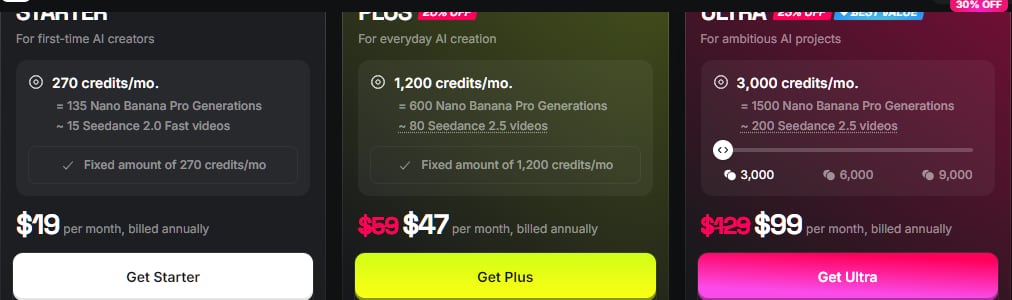
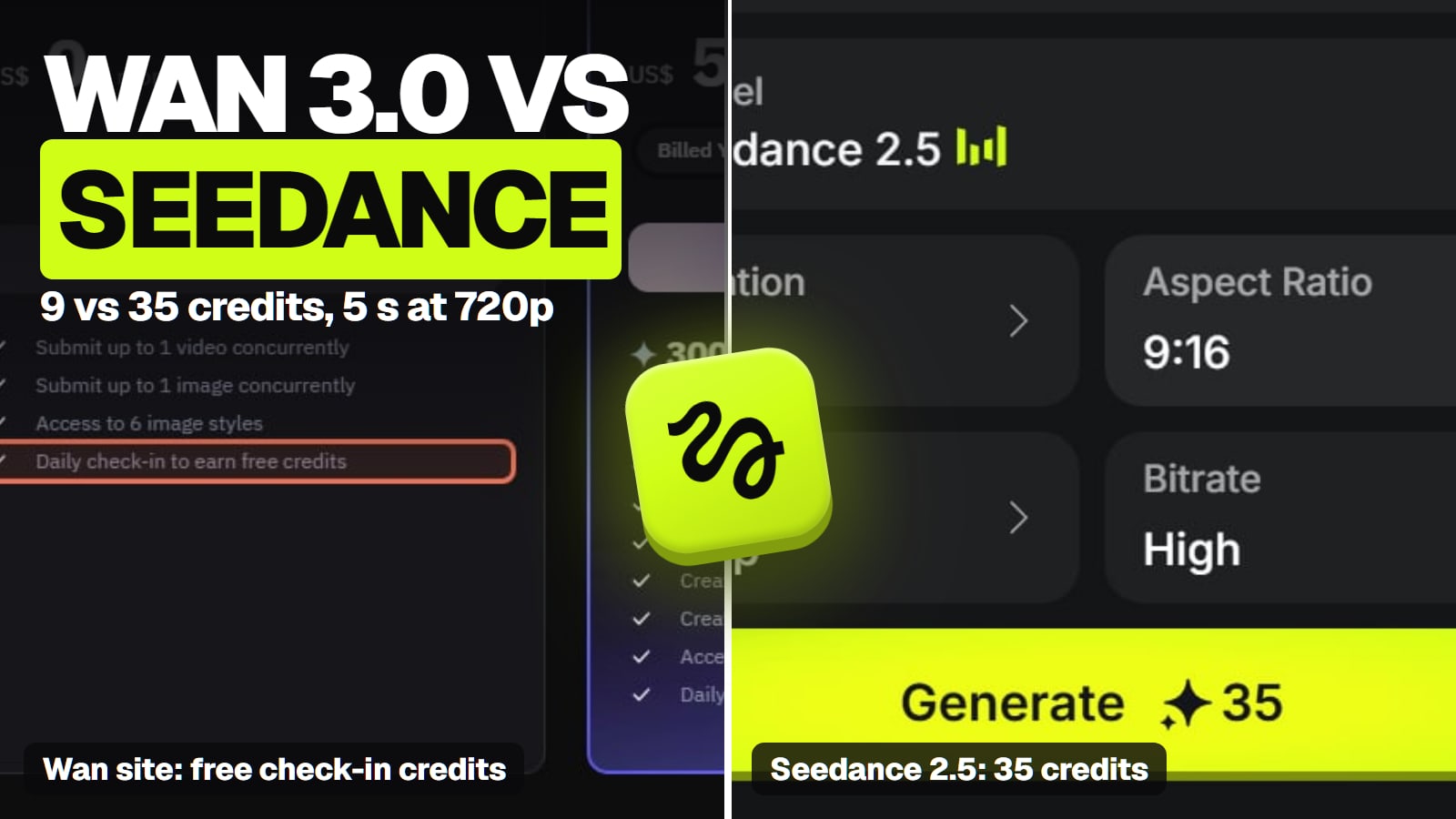
The Kling number is from my own account: my last Kling 3.0 clip in Higgsfield cost 7.5 credits, and the Ultra plan is $99 outside sales ($50 in the Black Friday sale, read Nov 17) a month (billed yearly) for 3,000 credits. If you buy extra credits instead, Higgsfield's top-up packs work out to about 19 credits per dollar, so the same clip costs closer to $0.39. For Kling 4.0 and Seedance 2.5 on the same brief, with what each clip cost on Nov 7, see Kling vs Seedance.
Higgsfield's plans as I read them on Nov 1, 2026. The "≈ 200 Seedance 2.5 videos" line on Ultra is where the $0.50-a-clip figure comes from.
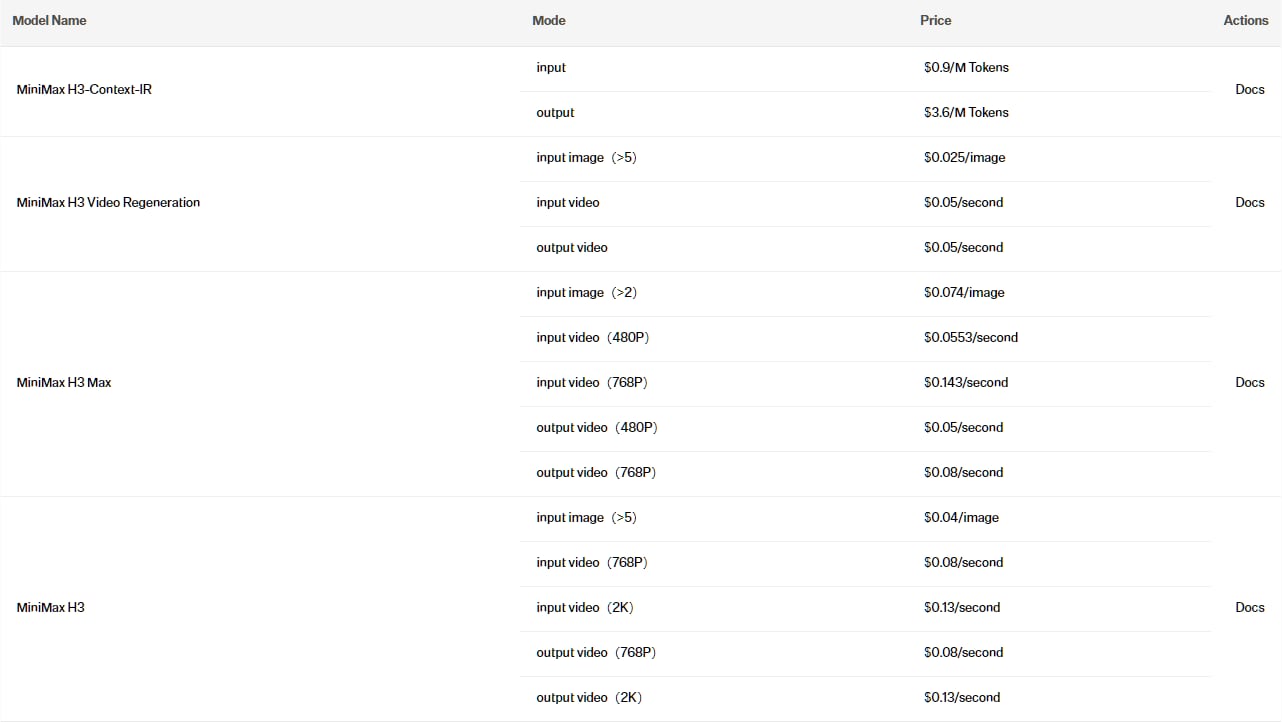
Novita's MiniMax H3 prices, read Nov 1, 2026. You pay per second of output, plus small fees for extra reference images.
API prices line up with what people report paying. In October, a r/StableDiffusion user running MiniMax through APIs said it cost them "about 50c for 10 seconds" on one service, 60 cents on fal and $1 on Runway, and asked when it's worth running their own instead. The most useful reply set the rule I used here: compare only "clips you'd actually keep".
The rented GPU looks free. It isn't.
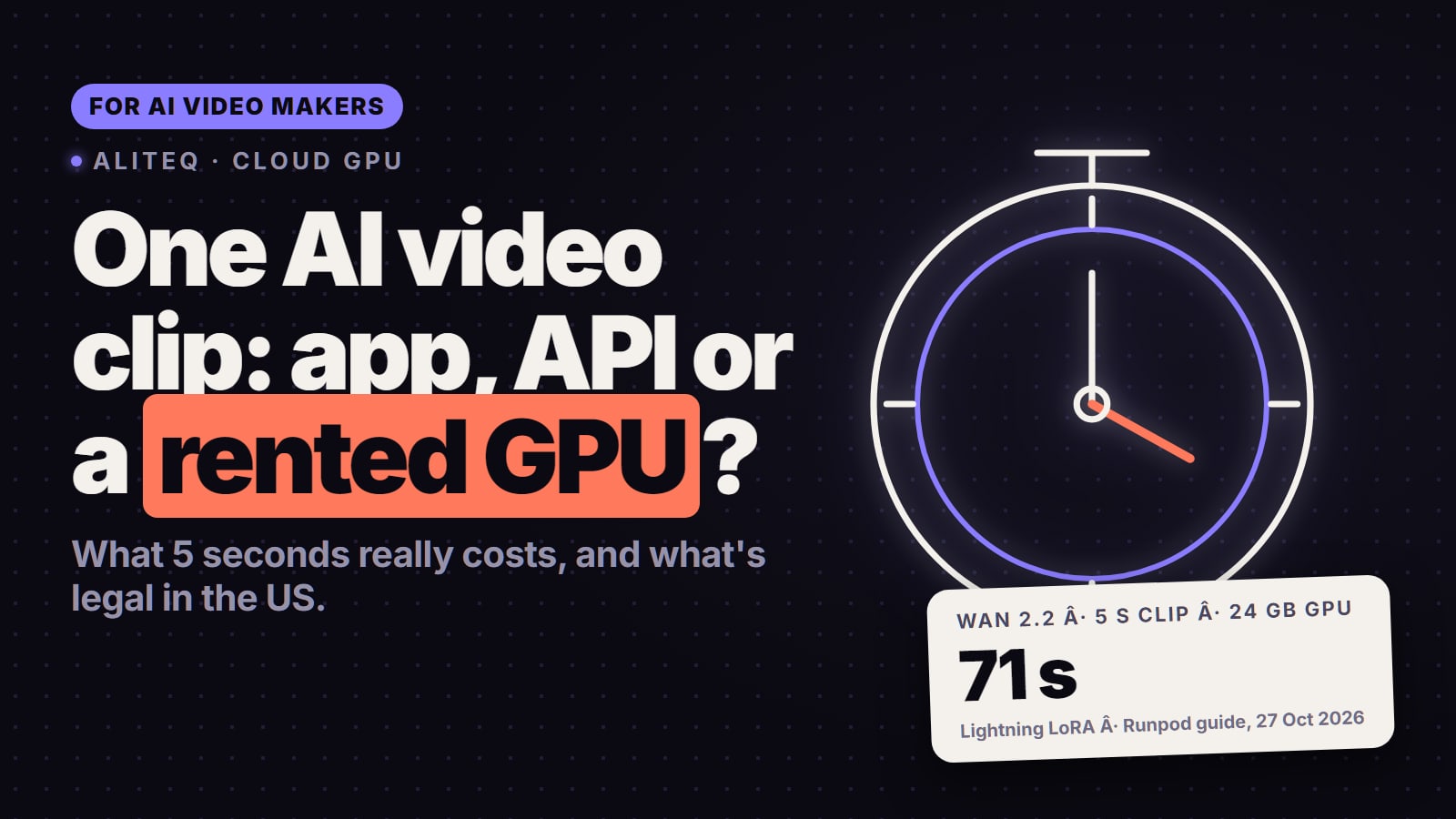
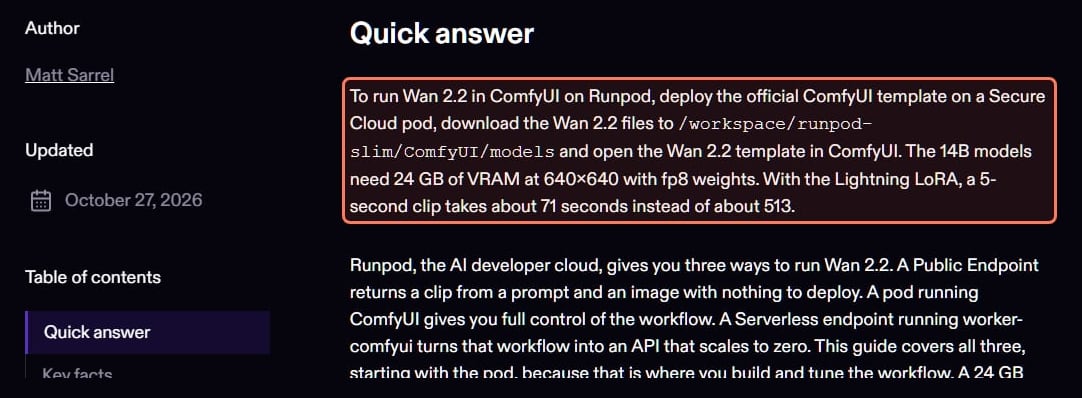
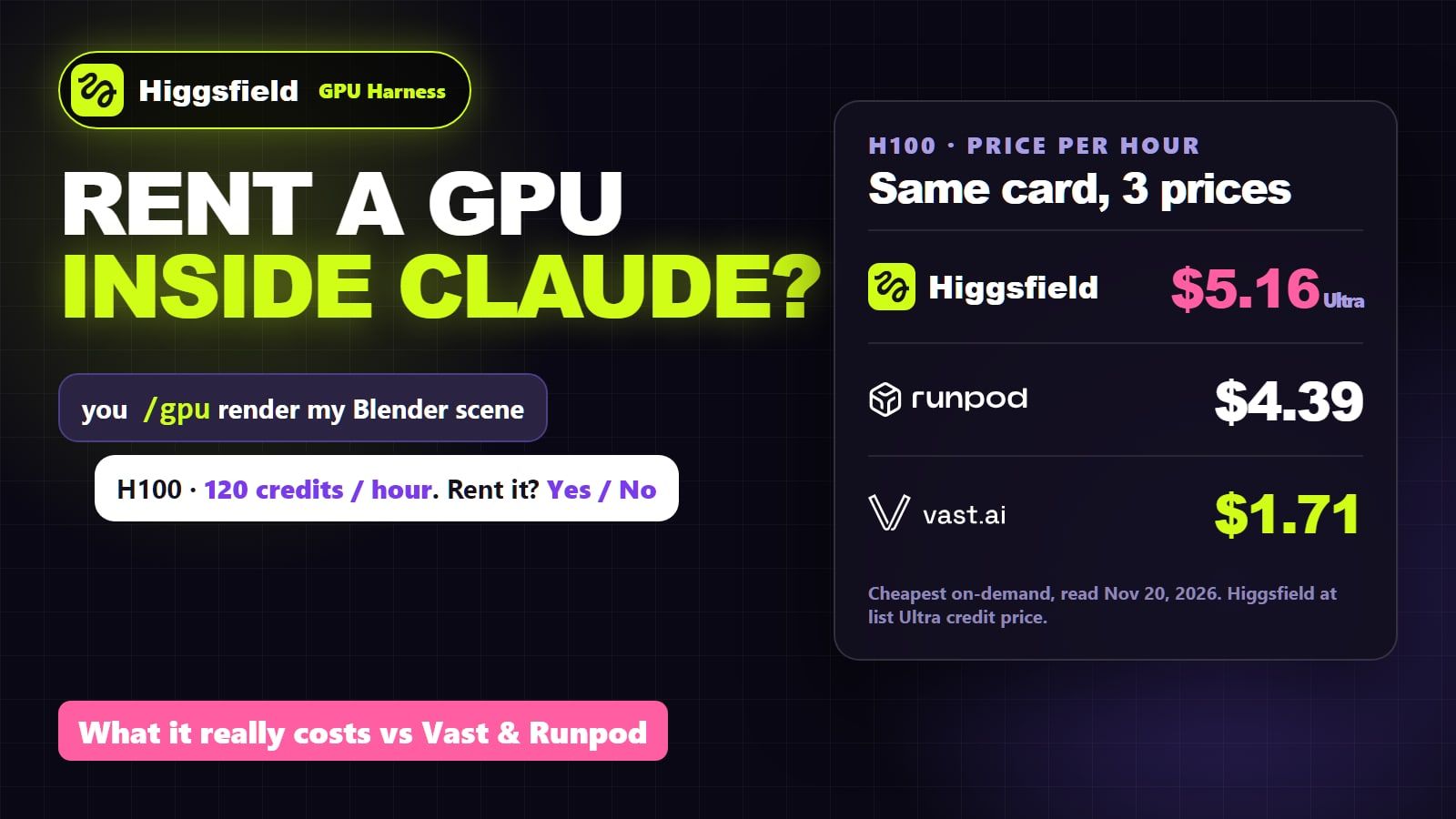
On paper, renting is absurdly cheap. Runpod's own Wan 2.2 guide puts it plainly: with the Lightning LoRA, "a 5-second clip takes about 71 seconds instead of about 513". On an RTX 4090 at Runpod's Secure Cloud price of $0.89 an hour, that's about 2 cents a clip. Higgsfield now sits in between: its GPU Harness rents the card from your Claude chat and bills plan credits, and what that costs vs Vast and Runpod is on its own page.
Runpod's Wan 2.2 guide (updated Oct 27, 2026), the source of the render times.
A note on that price, because it trips people up. Runpod still lists a cheaper Community Cloud (an RTX 4090 for $0.34 an hour in its own price feed today), but it stopped taking new Community hosts and its new deploy page shows Secure Cloud. In September someone in r/RunPod asked "Why is runpod now so expensive?" after ChatGPT promised them the cheaper tier and they could only find Secure Cloud. I use the price a new user will actually see.
Then you read the threads from people who actually do it, and three costs show up that the hourly price hides.
Setup and downloads. Video models are big, and a fresh pod has to download them. One r/generativeAI user who runs MiniMax H3 on Runpod warned that for larger models "you might burn 30-50 minutes just on downloads". You pay for those minutes.
The first render.Someone in r/StableDiffusion rented a B200 to test MiniMax H3 and wrote that "the first initial render will always take around 10+ minutes to fully load the models". After that, a 10-second clip took them about a minute and a half at 15 steps.
Idle time. You pay while you write prompts, fix a red node in ComfyUI, and look at the result. In r/aivideomaking, the complaint was that a pod "charges for both active and idle time rather than pay per render".
Finding a GPU at all."It has become impossible to find an available GPU" was a r/RunPod post in October, and an August thread in r/StableDiffusion was simply titled "Runpod is basically unusable." The usual fixes from replies: switch data center, or use Runpod's "Deploy when available" queue. Either way, availability is part of the price.
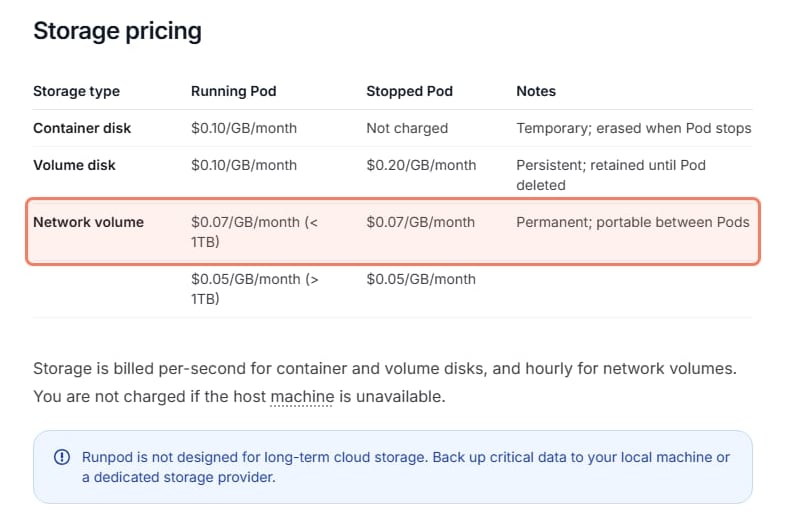
Storage. To skip the downloads next time, you keep the models on disk, and disk is billed every month. Runpod charges $0.07 per GB a month for a network volume, whether a pod is running or not. On Vast, our read of 512 rentable offers on 1 Nov found a median storage price of $0.20 per GB a month, and Vast's docs say storage is "billed continuously while your instance exists, regardless of running state".
Runpod's storage prices from its docs, read Nov 1, 2026.
So I built a realistic month instead of a perfect one.
A real month on a rented RTX 4090 ($0.89/hr, Runpod Secure Cloud)
Clip renders (Lightning, each clip tried twice)
20 clips a month
0.8 GPU-hours
100 clips a month
3.9 GPU-hours
Setup and downloads (30 min per session)
20 clips a month
2 sessions, 1 hour
100 clips a month
4 sessions, 2 hours
GPU cost
20 clips a month
$1.59
100 clips a month
$5.29
Model storage, 100 GB network volume
20 clips a month
$7.00
100 clips a month
$7.00
Cost per kept clip
20 clips a month
≈ $0.43
100 clips a month
≈ $0.12
20 clips a month
100 clips a month
Clip renders (Lightning, each clip tried twice)
0.8 GPU-hours
3.9 GPU-hours
Setup and downloads (30 min per session)
2 sessions, 1 hour
4 sessions, 2 hours
GPU cost
$1.59
$5.29
Model storage, 100 GB network volume
$7.00
$7.00
Cost per kept clip
≈ $0.43
≈ $0.12
The inputs are mine and easy to change: twice the renders you keep, half an hour of setup per session, 100 GB of models on a network volume. Switch to the 20-step path and 100 clips cost about $0.34 each. The pattern holds either way. At 20 clips a month, renting costs as much as the app or more. At 100, it costs a fraction. Storage is the fixed cost that makes small batches expensive.
One thing I only noticed when I clicked our own Runpod link: new users get a bonus. Runpod's referral rules say that if you sign up with Google and load $10, you get a credit that is "a random weighted bonus between $5 and $500" outside Europe (a fixed $5 in Europe), valid for 90 days. Runpod doesn't publish the odds, so plan on the low end, but it covers the first session's setup time at the very least.
What I saw when I clicked our own Runpod link on Nov 1, 2026.
What does one AI video clip cost on a rented GPU?
The Runpod guide above gives one card and one resolution. People renting for video ask for more than that. "How many 16:9 videos are you actually getting per hour?" was a question in r/StableDiffusion this year, and "Is RunPod + ComfyUI the cheapest way to make AI videos?" asked the same thing in money. So I took the published time per clip for the open models people actually run, from the model makers' own tables and from Reddit posts that state the GPU and every setting, and multiplied each one by the hourly price on our live table. I didn't run these jobs myself. The times are other people's, and the arithmetic is mine.
Cost per clip on a rented GPU (prices read Nov 18, 2026, 00:53 UTC)
LTX-2.5, stock ComfyUI template, 1920x1088, 10 s with audio, models loaded, RTX PRO 6000 (one Reddit user)
232 s
$1.73
$2.69
≈ $0.11 / $0.17
How to read it. Cost per clip is our arithmetic: seconds per clip ÷ 3,600 × the hourly price. Vast prices are the median on-demand single-GPU offer in our hourly snapshot (captured 00:20 UTC on Nov 18); Runpod prices are its Secure Cloud on-demand list prices from the same snapshot. Vast had few H100 offers in that read, so its H100 median moves a lot from hour to hour. The A100 rows use Vast's A100 SXM4 offers and Runpod's A100 SXM. Live numbers: our cloud GPU table.
Two kinds of rows sit in this table, and they don't mix. The official script rows come from the "Computational Efficiency" table in Wan 2.2's GitHub README: a single GPU running Wan's own research script at the repo defaults (40 steps and 81 frames for A14B, 50 steps and 121 frames at 24 fps for TI2V-5B), with model offloading on, averaged after warm-up. That's the slow, full-quality path, and it's why an A14B clip takes minutes. The ComfyUI rows are single runs by individual users on Reddit: the Wan 5B row from a r/comfyui post in September (the poster says they do community work for the GPU host gpuhub), the LTX-2.5 5090 row from a r/comfyui benchmark in October, and the PRO 6000 row from a r/comfyui post in September on the server edition of the card. Another user reported 130 seconds for a 10-second 1080p LTX-2.5 clip from an image on a PRO 6000 capped at 600 W (r/comfyui, October), so treat the 232 seconds as one data point, not a fixed number. Fewer steps or a speed-up LoRA cut these times a lot; the same 5090 user got the Wan 5B clip down to 89 seconds at 10 steps.
How many clips per hour? That's 3,600 ÷ seconds per clip, render time only:
Wan 2.2 TI2V-5B, ComfyUI 20 steps, RTX 5090: about 23 clips an hour
Wan 2.2 TI2V-5B, official 50 steps, RTX 4090: about 6.7
Wan 2.2 A14B 480p, official, H100: about 11
Wan 2.2 A14B 720p, official, H100: about 3.5
Wan 2.2 A14B 480p, official, A100: about 4.6
Wan 2.2 A14B 720p, official, A100: about 1.3
LTX-2.5 5 s at 1280x736, RTX 5090: about 169
LTX-2.5 10 s at 1080p with audio, RTX PRO 6000: about 15.6
There's no MiniMax H3 row on purpose. Its licence (Section I.5 of the LICENSE file on Hugging Face, read Nov 18, 2026) excludes the European Union, the United Kingdom, South Korea and the United States, so this page doesn't price running it yourself (more on that in the next section). Wan 2.2 is released under Apache 2.0, per its Hugging Face model card, so it carries no territory clause.
The licence line most guides skip
Here is the part that changed my answer. Since its release in August, MiniMax H3 is the model I saw recommended most in these threads, and more than one commenter called Wan 2.2 "obsolete" next to it. It's an open-weight model, it makes video with native stereo audio, and there are Runpod templates for it.
But its licence has a territory clause. I read it in the model's own LICENSE file on Hugging Face.
MiniMax H3's licence, lines 3 to 10 (license date Aug 2, 2026). The highlighted lines define where the free licence does not apply.
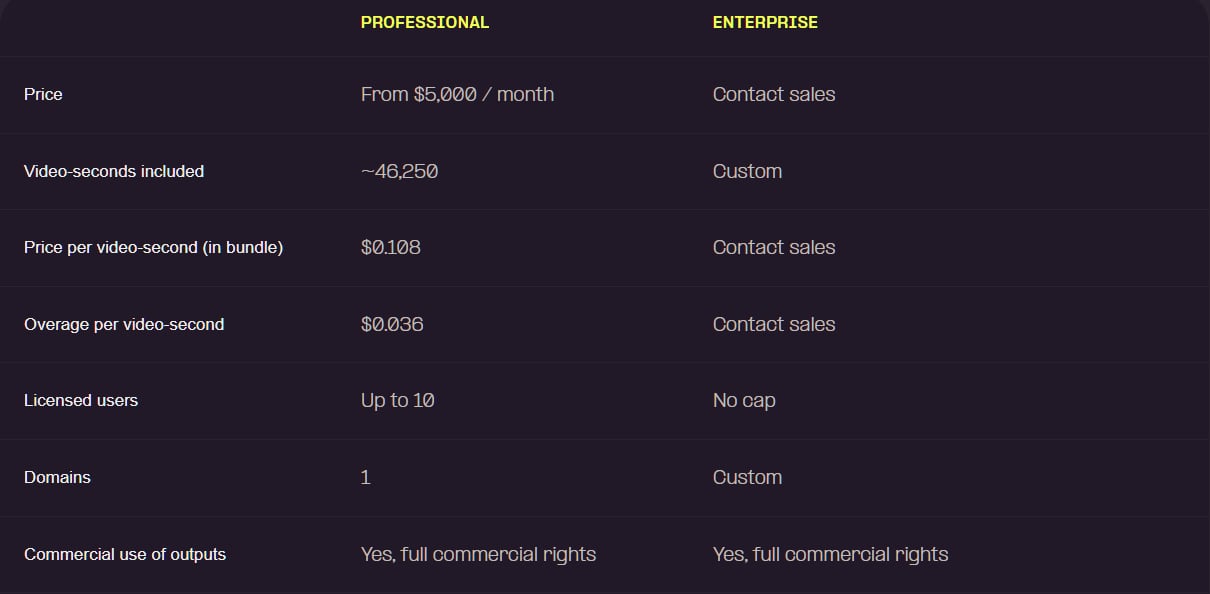
"Excluded Territories" means "the European Union, the United Kingdom, the Republic of Korea and the United States of America". The licence also says you may not use the model or its outputs outside the territory it covers. In a later clarification, MiniMax said the model can be used in those regions "through a formal authorization process". In practice that's a commercial licence, and Comfy says it is "the only official reseller of MiniMax commercial-use licenses", with the Professional tier starting at $5,000 a month.
Comfy's MiniMax H3 licence tiers, read Nov 1, 2026.
So if you're in the US and you rent a GPU to run MiniMax H3's open weights, you're outside the licence unless you've bought one. I'm not a lawyer and this isn't legal advice, but the text is not ambiguous. If you want H3 in the US, the straightforward routes are hosted services: Higgsfield offers MiniMax H3 and H3 Max in its app, and Novita sells it by the second through its API. Wan 2.2 is the clean open option: its repository is Apache 2.0, with no territory clause.
To be fair to the people running it anyway: a r/LocalLLaMA post titled "PSA: reminder that Minimax H3 is forbidden to use in US, EU, UK, and South Korea" got 149 comments in August, and the most upvoted reply was a shrug. For a hobby clip on your own machine, many people clearly don't care. My line is simpler: the moment the video earns money, for a client, a store or a monetized channel, the risk is yours, so I'd pick a route that's licensed.
So which one would I pick?
It depends on two numbers: how many clips you make a month, and which model you need.
Verdict
App for a few clips, API for building, rented GPU for volume
Under about 25 clips a month, or if you want the newest closed models with sound, an app wins on cost and on your time. If you're building something that calls a model on demand, pay per second through an API. If you make 50 or more clips a month and Wan 2.2's look is good enough, rent a 24 GB GPU, keep your models on a network volume, and use the Lightning LoRA for drafts.
Best for: Faceless channels and product videos at volume: rent. Occasional creators: Higgsfield. Developers and apps: Novita's API. In the US: skip self-hosted MiniMax H3.
One thing the numbers don't capture, and the most upvoted comment I found makes the point well. A creator in r/comfyui who moved from renting to their own RTX 5090 compared the costs, and the top reply wasn't about money at all. It was about creativity: "Something about watching the clock puts me in a kind of 'defensive' mindset." If paying by the minute makes you experiment less, that's a real cost too.
Is it cheaper to rent a GPU than pay for an AI video app?
Only at volume. A rented RTX 4090 renders a 5-second Wan 2.2 clip for about 2 cents of GPU time at Runpod's Secure Cloud price, but setup, retries and model storage add a fixed monthly cost. With 100 GB of models on a Runpod network volume, renting comes to about $0.43 a clip at 20 clips a month and about $0.12 at 100 clips, against about $0.25 to $0.50 in Higgsfield.
How long does Wan 2.2 take to generate a 5-second video?
Runpod's guide, using ComfyUI's Wan 2.2 template on a 24 GB card at 640x640, says about 71 seconds with the Lightning LoRA and about 513 seconds without it. Higher resolutions and other settings take longer.
Can I use MiniMax H3 in the United States?
Not under the free open-weight licence. Its licence excludes the United States, the EU, the UK and South Korea, and MiniMax says use there needs a formal authorization. Hosted services such as Higgsfield and Novita's API offer MiniMax H3 without you running the weights yourself.
How much does MiniMax H3 cost per second?
Novita's price on Nov 1, 2026 was $0.08 per second of 768p output and $0.13 per second at 2K, so a 5-second 768p clip is about $0.40.
What GPU do I need for Wan 2.2?
Runpod's guide says the 14B models need 24 GB of VRAM at 640x640 with fp8 weights, such as an RTX 4090. Larger resolutions or fp16 weights need a 48 GB card.
How many 16:9 videos can you make per hour on a rented GPU?
Counting render time only, about 23 five-second Wan 2.2 5B clips an hour on an RTX 5090 in ComfyUI at 20 steps, and about 169 five-second LTX-2.5 clips at 1280x736 on the same card once the model is loaded, per two Reddit users' runs. Wan 2.2's big A14B model with its official script manages about 3.5 clips an hour at 720p on an H100, per Wan's own table.
Is RunPod + ComfyUI the cheapest way to make AI videos?
Per clip it can be very cheap: a Wan 2.2 5B clip on a Runpod RTX 5090 at $1.39 an hour works out to about 6 cents of GPU time, and about 3 cents at the median Vast price on Nov 18, 2026. The catch is setup, model downloads and storage, which you pay for even when you aren't rendering, so it only beats an app or an API once you make clips in volume.
How much does one Wan 2.2 clip cost on a rented H100 or A100?
With Wan's official script at 720p, one 5-second A14B clip takes about 1,042 seconds on an H100 and 2,736 seconds on an A100, which came to about $0.96 to $1.27 and $0.64 to $1.66 at Vast and Runpod prices on Nov 18, 2026. At 480p it's about $0.18 to $0.48 per clip.
Higgsfield sales like 11.11 and Black Friday change prices for a few days at a time. When one starts, we read the real prices on Higgsfield's own page and email you what changed.
Written and sent by hand. One-click unsubscribe in every email. Emails may contain referral links.