Seedance 2.5, Google's Veo 3.1, MiniMax's Hailuo and H3, Wan 3.0, Grok Imagine and Runway, matched to the reason you're leaving Kling. What each one does best, where to use it, what a clip costs, its free option, and what happened when we gave Kling 4.0 and Seedance 2.5 the same prompt.
This post contains affiliate links. If you buy through them, Aliteq may earn a commission — at no extra cost to you. Prices change; check the seller’s own page for today’s price.
Share
What should you use instead of Kling? It depends on why you're leaving, and sometimes the answer is to stay. We read Higgsfield's model catalogue and the makers' own pages, and priced and ran Kling 4.0 and Seedance 2.5, on November 7, 2026; free plans, plan prices and the other credit costs come from our November 3 checks, and every figure carries the date we read it. Kling's own plans, credit prices and every guide we've written about it live on our Kling AI hub, from the free plan to the price of a clip.
Why are you leaving Kling? Start with the reason
The reason decides the alternative, and the first two below aren't about the model at all.
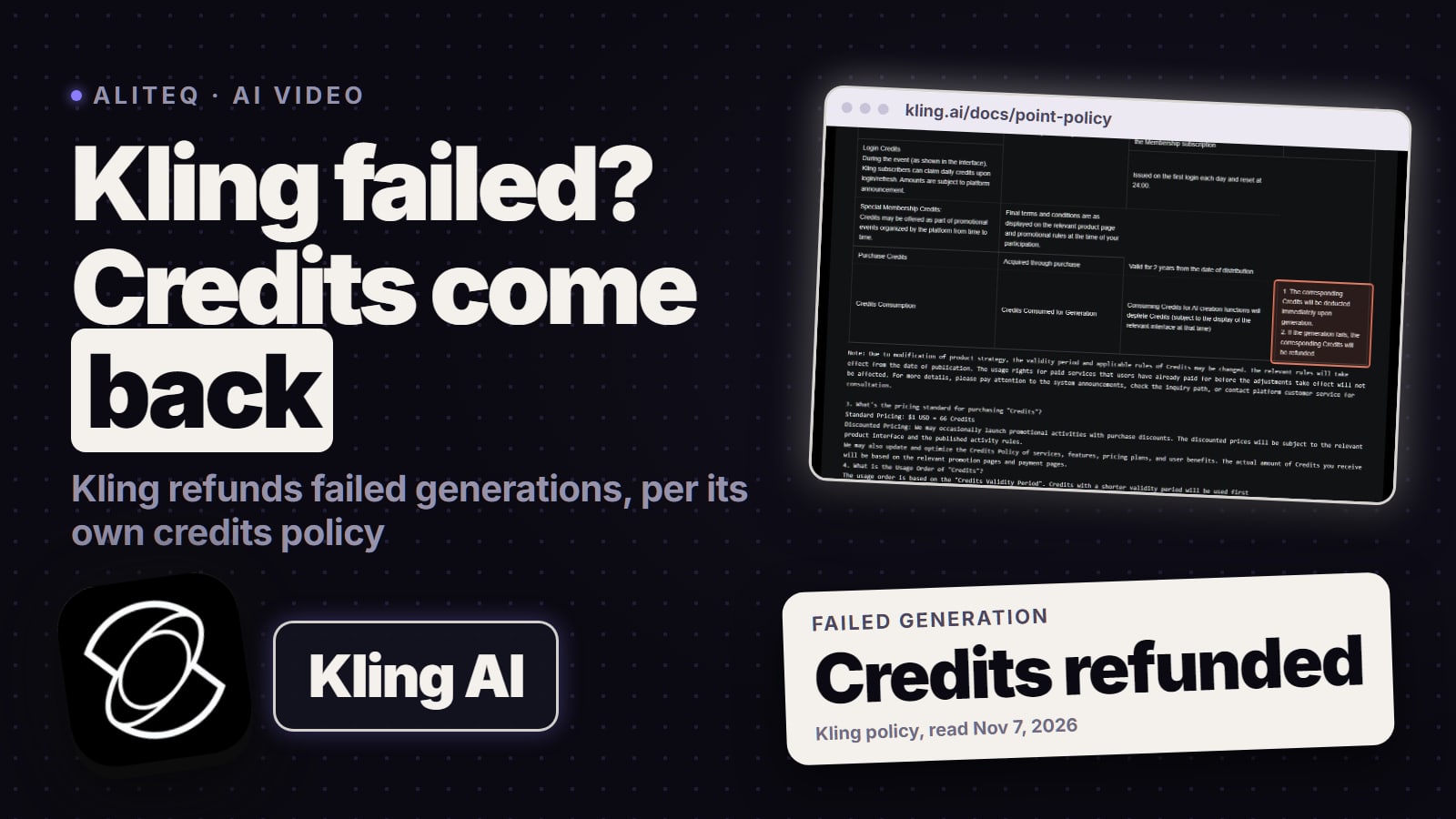
"Too busy", stuck or failed. That's usually a queue or account problem, not a model problem. Kling's Credits Policy (read Nov 7) keeps fast-track generation for paying members and refunds failed generations. Work through why Kling isn't working and how to fix it before you change models.
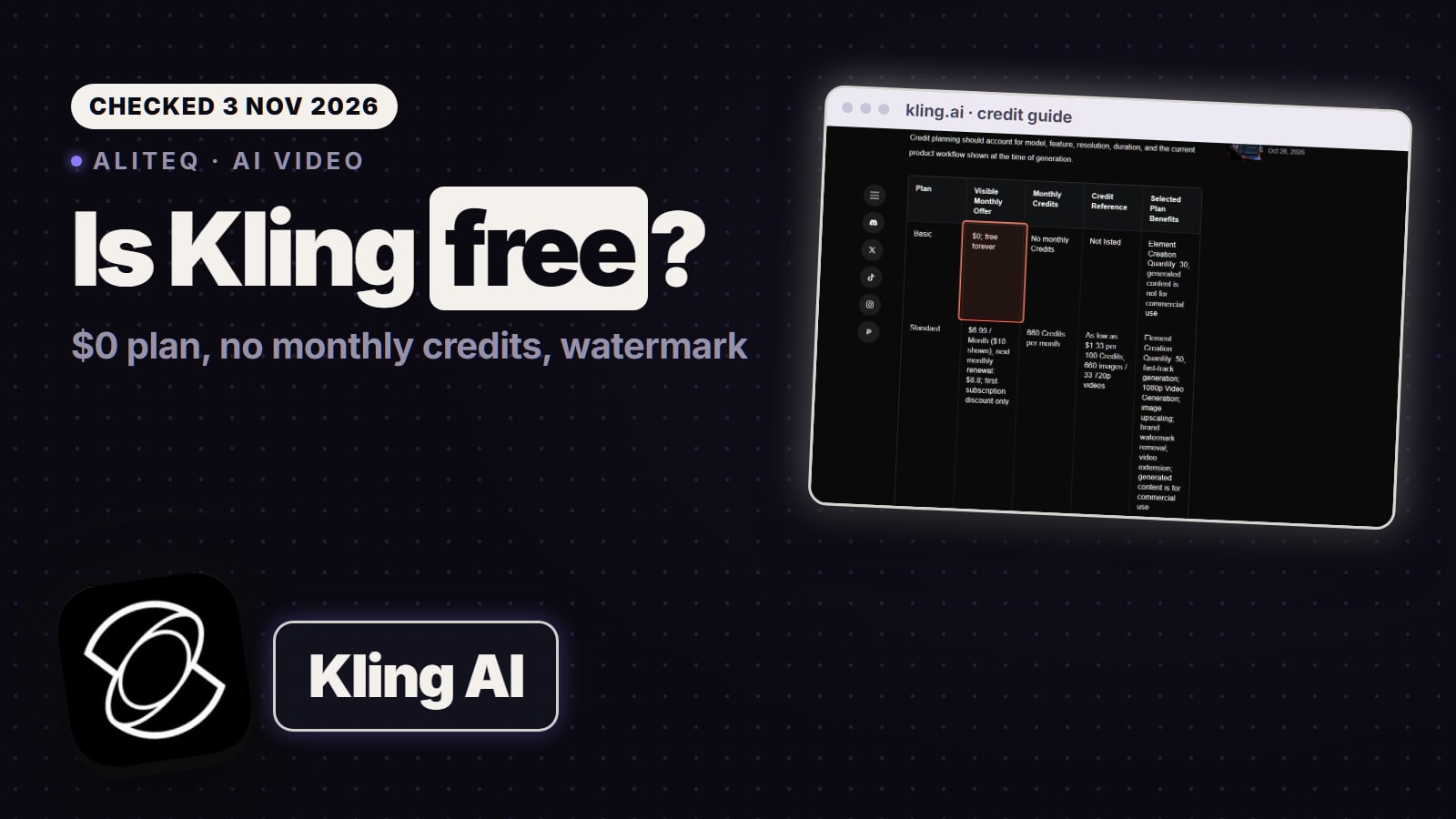
The free plan runs out. Kling's Basic plan has no monthly credits (free credits come from sign-up, a monthly login allowance and promotions), adds a watermark and isn't for commercial use (Kling's own pages, Nov 3); what Kling's free plan really includes has the details. Every alternative's free tier has its own catch, listed below.
It keeps your photo's scene when you want a new one. In our November 3 product test Kling 3.0, given the product photo as its start frame, kept the photo's wooden table and landscape shape, while Seedance 2.5, given the same photo as a reference, built the vertical grey studio the brief asked for (our 10-clip cost-per-usable-clip test). Kling 4.0 and Kling 3.0 Omni take reference images too; we haven't tested their reference modes against Seedance (our Nov 7 test was text-to-video).
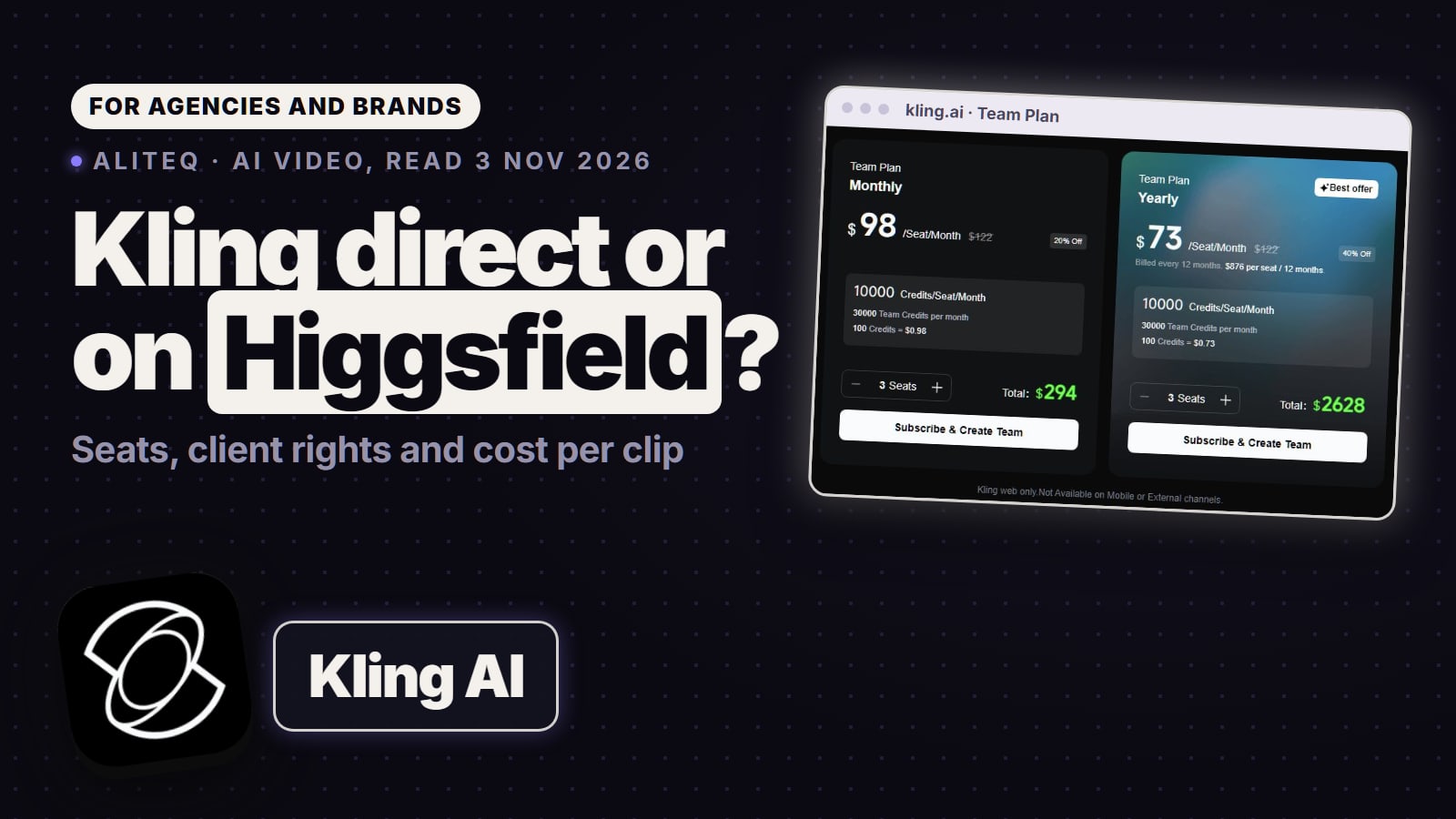
You'd rather have several models on one bill. Higgsfield runs Kling next to most of the alternatives below. If Kling is most of what you make, though, Kling's own plans usually cost less per clip (whether to buy Kling direct or on Higgsfield, priced per clip, Nov 3, 2026).
Kling alternatives compared at a glance
Clip lengths come from Higgsfield's model catalogue, read through its own API on November 7, 2026. Credits are what Higgsfield showed on the date in brackets (its Generate button or its cost check), and several were discounts that day. Free routes are from each maker's own pages, read on November 3, 2026 for our earlier guides (Grok's on November 7).
Kling 4.0 and six alternatives (clip lengths from Higgsfield's catalogue, Nov 7, 2026; prices dated per cell)
Kling 4.0 (Kuaishou), the baseline
Best at, per the maker or Higgsfield
Video from text, ordered keyframes or references, or editing a clip
Clip length on Higgsfield
3 to 30 s, 720p or 1080p
Higgsfield credits (date read)
11.25 for 5 s at 720p (Nov 7)
Official free route (read Nov 3 unless noted)
Basic plan with no monthly credits (free credits from sign-up and a monthly login allowance), a watermark and no commercial use
Seedance 2.5 (ByteDance)
Best at, per the maker or Higgsfield
Audio and video generated together, built for 30-second storytelling
Clip length on Higgsfield
4 to 30 s, 480p to 1080p
Higgsfield credits (date read)
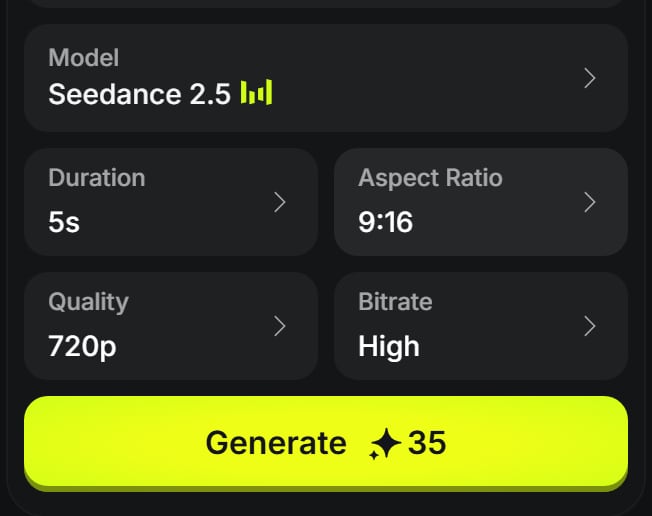
35 for 5 s at 720p (Nov 7)
Official free route (read Nov 3 unless noted)
Dreamina, 120 credits a day for US free accounts, not enough for one Seedance 2.5 clip
Veo 3.1 and Veo 3.1 Lite (Google)
Best at, per the maker or Higgsfield
Realistic, cinematic clips with native audio
Clip length on Higgsfield
4, 6 or 8 s
Higgsfield credits (date read)
80 (Veo 3.1) or 12 (Lite, 720p, sound off by default) for 8 s (Nov 3)
Official free route (read Nov 3 unless noted)
Google Flow, 50 credits a day; no 100-credit Quality clip fits
MiniMax Hailuo 2.3 and H3 (MiniMax)
Best at, per the maker or Higgsfield
Fast, high-dynamic video; H3 up to 15 s at 2K with stereo sound
Clip length on Higgsfield
Hailuo 6 or 10 s; H3 4 to 15 s at 2K
Higgsfield credits (date read)
Hailuo 2.3, 6 for 6 s at 768p; H3, 10 for 5 s at 2K, 20 listed (Nov 3)
Official free route (read Nov 3 unless noted)
A one-time welcome pack that expires after three days
Wan 3.0 (Alibaba)
Best at, per the maker or Higgsfield
Strong first and last frame control; the open Wan 2.2 runs on your own GPU
Clip length on Higgsfield
2 to 30 s, 480p to 1080p
Higgsfield credits (date read)
9 for 5 s at 720p, 13 listed (Nov 3)
Official free route (read Nov 3 unless noted)
Daily check-in credits on Alibaba's Wan site
Grok Imagine Video 1.5 (xAI)
Best at, per the maker or Higgsfield
Sound effects, ambience and dialogue made in the same pass as the picture
Clip length on Higgsfield
2 to 15 s, 480p to 1080p
Higgsfield credits (date read)
22.5 for 5 s at 720p (Oct 26, cost check)
Official free route (read Nov 3 unless noted)
xAI's page links a "Try for free" button to grok.com, with no limits stated (Nov 7)
Runway Gen-4.5 and Aleph (Runway)
Best at, per the maker or Higgsfield
Runway's own models; Aleph edits existing footage
Clip length on Higgsfield
Not on Higgsfield
Higgsfield credits (date read)
Not on Higgsfield; Gen-4.5 is 60 Runway credits per 5 s (Nov 3)
Official free route (read Nov 3 unless noted)
A Free plan on Runway's pricing page
Best at, per the maker or Higgsfield
Clip length on Higgsfield
Higgsfield credits (date read)
Official free route (read Nov 3 unless noted)
Kling 4.0 (Kuaishou), the baseline
Video from text, ordered keyframes or references, or editing a clip
3 to 30 s, 720p or 1080p
11.25 for 5 s at 720p (Nov 7)
Basic plan with no monthly credits (free credits from sign-up and a monthly login allowance), a watermark and no commercial use
Seedance 2.5 (ByteDance)
Audio and video generated together, built for 30-second storytelling
4 to 30 s, 480p to 1080p
35 for 5 s at 720p (Nov 7)
Dreamina, 120 credits a day for US free accounts, not enough for one Seedance 2.5 clip
Veo 3.1 and Veo 3.1 Lite (Google)
Realistic, cinematic clips with native audio
4, 6 or 8 s
80 (Veo 3.1) or 12 (Lite, 720p, sound off by default) for 8 s (Nov 3)
Google Flow, 50 credits a day; no 100-credit Quality clip fits
MiniMax Hailuo 2.3 and H3 (MiniMax)
Fast, high-dynamic video; H3 up to 15 s at 2K with stereo sound
Hailuo 6 or 10 s; H3 4 to 15 s at 2K
Hailuo 2.3, 6 for 6 s at 768p; H3, 10 for 5 s at 2K, 20 listed (Nov 3)
A one-time welcome pack that expires after three days
Wan 3.0 (Alibaba)
Strong first and last frame control; the open Wan 2.2 runs on your own GPU
2 to 30 s, 480p to 1080p
9 for 5 s at 720p, 13 listed (Nov 3)
Daily check-in credits on Alibaba's Wan site
Grok Imagine Video 1.5 (xAI)
Sound effects, ambience and dialogue made in the same pass as the picture
2 to 15 s, 480p to 1080p
22.5 for 5 s at 720p (Oct 26, cost check)
xAI's page links a "Try for free" button to grok.com, with no limits stated (Nov 7)
Runway Gen-4.5 and Aleph (Runway)
Runway's own models; Aleph edits existing footage
Not on Higgsfield
Not on Higgsfield; Gen-4.5 is 60 Runway credits per 5 s (Nov 3)
A Free plan on Runway's pricing page
The six alternatives, one by one
1. Seedance 2.5 (ByteDance): realistic people and new scenes
ByteDance calls Seedance 2.5 "a next-generation audio-video joint generation model, built for 30-second storytelling", and says it can "Create videos up to 30 seconds in a single generation", with the "option to extend twice" (Seedance 2.5 page, read Nov 7). Higgsfield's model guide (re-read Nov 7) sends "realistic human motion" to Seedance, and it's the one alternative we've run against Kling ourselves, twice.
Where: ByteDance's Seedance page points to its Dola app and the BytePlus playground. Dreamina, CapCut's AI studio, runs it too, and so does Higgsfield. BytePlus's own announcement says its platform isn't available in the US (read Nov 3).
On Higgsfield: 4 to 30 seconds at 480p, 720p or 1080p, sound on by default, with image, video and audio references, video edit and video extension. A 5-second clip is 15 credits at 480p and 80 at 1080p (Nov 3), and 35 at 720p (Nov 7). Outside the US, a 480p draft can be finalized at 1080p within seven days; Higgsfield's changelog says Draft Mode isn't offered in the US (read Nov 7).
Free option: Dreamina gives US free accounts 120 credits a day (Nov 3), about 3 seconds of Seedance 2.5 at Dreamina's 37 credits a second, less than the shortest clip, and Dreamina's own pages disagree on whether free credits reach Seedance 2.5 at all. Here's every free Seedance route and its catch.
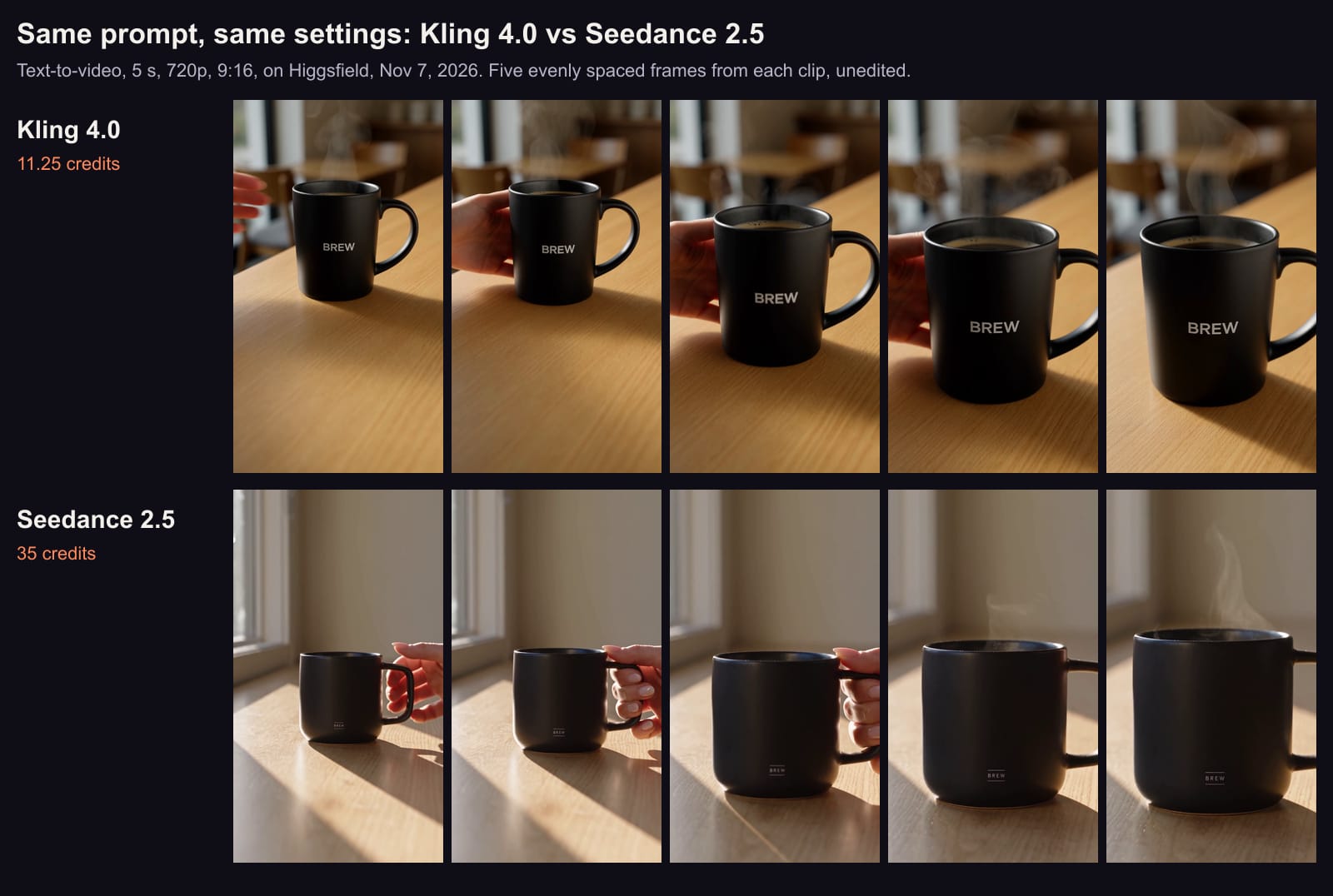
Watch out: about three times Kling 4.0's credits per second at 720p (7 against 2.25 on Nov 7, our arithmetic). In our one November 7 run its clip of the café prompt also came back slower, set in a plain room rather than a café and lit with hard sun stripes where we'd asked for soft shadows.
2. Google Veo 3.1 and Veo 3.1 Lite: realistic clips with sound
Google DeepMind calls Veo 3.1 "Our leading video generation model, designed to empower filmmakers and storytellers", and its Veo page says "Veo 3 lets you add sound effects, ambient noise, and even dialogue to your creations – generating all audio natively" (read Nov 7). Higgsfield's catalogue describes Veo 3.1 as "Ultra-realistic, top-tier cinematic quality" and Veo 3.1 Lite as "Fast, affordable, budget batch clips".
Where: Google Flow, Google's AI filmmaking tool, on Google AI plans; and Higgsfield, which offers Veo 3.1 in a best-quality and a Fast variant, plus Veo 3.1 Lite.
On Higgsfield: 4, 6 or 8 seconds. On November 3 an 8-second clip cost 80 credits on Veo 3.1, 32 on Veo 3.1 Fast and 12 on Veo 3.1 Lite at 720p; Higgsfield's catalogue sets Lite's sound off by default (Nov 7).
Free option: Google Flow's 50 credits a day (Nov 3), though Google's own getting-started page lists a paid Google AI plan as a requirement, non-subscribers may be blocked at peak hours, and an 8-second Veo 3.1 Quality clip costs 100 Flow credits. Here's what Veo's free Flow credits really buy.
Watch out: short takes, 8 seconds against Kling 4.0's 30. And if Veo is all you want, Google's own plans cost less per clip: about $2.00 on Google AI Pro against $3.44 on Higgsfield Ultra billed monthly ($129 for 3,000) for an 8-second Veo 3.1 clip on Nov 3, by our arithmetic. Veo 3.1 direct from Google or on Higgsfield, priced per clip has the plan-by-plan math.
3. MiniMax Hailuo and H3: fast, cheap drafts
MiniMax traces its video line "From Hailuo 01 and Hailuo 02 to H3", and says H3 generates video "with native stereo sound, up to 15 seconds at 2K resolution" (MiniMax H3 post, July 31, 2026, read Nov 7). Higgsfield's model guide (re-read Nov 7) sends "high-dynamic video at fast speeds" to Minimax Hailuo, and its catalogue sums Hailuo up as "Natural physics, facial emotion, multiple variants".
Where: MiniMax's own app at hailuoai.video and its API; on Higgsfield as MiniMax H3, MiniMax H3 Max and Minimax Hailuo, including the 2.3 and 2.3 Fast versions.
On Higgsfield: Hailuo makes 6 or 10 seconds, H3 4 to 15 seconds at 2K and H3 Max 5 to 15 seconds at 480p or 768p. On November 3 a 6-second Hailuo 2.3 clip at 768p was 6 credits, and a 5-second H3 clip at 2K was 10 during a discount (20 listed).
Free option: a one-time welcome pack of credits that expires three days after it's granted, with watermarked downloads (Hailuo's terms, read Nov 3). Here's what Hailuo's free trial really gives.
Open weights, not licensed in the US: MiniMax calls H3 "An Open Model", and its weights are public on Hugging Face. Its MiniMax H3 Community License, though, lists the United States, the European Union, the United Kingdom and South Korea as "Excluded Territories", where you have to apply to MiniMax for a separate licence (read Nov 7). MiniMax's sample server commands use four GPUs and it publishes no single-GPU VRAM figure, so we don't point you to a card for it.
Watch out: reliability at busy times. In August a Hailuo subscriber wrote that "every single generation gets a "High Demand Failure" after reaching 100% on the render" (r/HailuoAiOfficial); Hailuo says failed generations cost no credits.
4. Wan 3.0 and the open Wan 2.2 (Alibaba): exact frames, or run it yourself
Higgsfield's model guide (re-read Nov 7) says Wan "gives you precise control over the first and last frame of a generation, useful when you need to continue a scene or match a specific start or end state". Its catalogue lists Wan 3.0 for "text-to-video, first/last frame video, and multimodal reference-to-video with native audio", with an optional thinking step it describes as "slower, better prompt adherence".
Where: Alibaba's wan.video and its Model Studio API; on Higgsfield as Wan 2.6, 2.7, 3.0 and 3.0 Prime.
On Higgsfield: 2 to 30 seconds at 480p to 1080p. On November 3 a 5-second Wan 3.0 clip at 720p was 9 credits (13 listed).
Free option: daily check-in credits on Alibaba's Wan site, and a 30-second API quota in Singapore only (both read Nov 3). Here are Wan 3's free routes and the open Wan 2.2.
Watch out: Wan 3.0 has no open weights. On November 7 Alibaba's Wan-AI page on Hugging Face listed nothing newer than Wan 2.2.
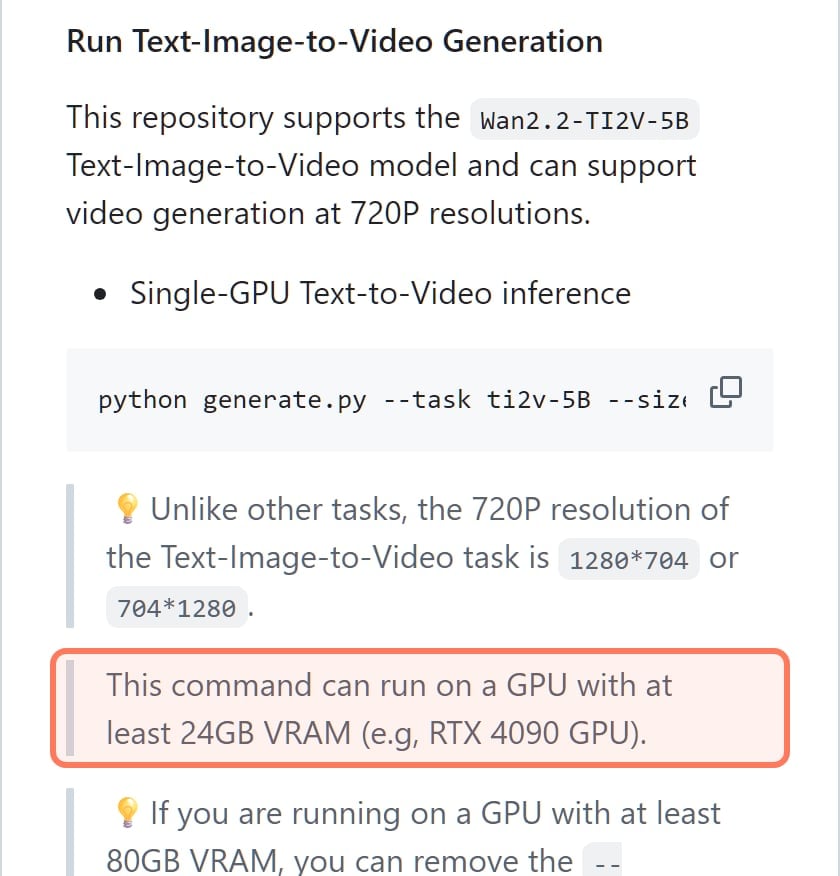
Running Wan yourself. Wan 2.2 is licensed Apache 2.0, and its own GitHub README says the 5B model, which does text- and image-to-video at 720p, "can run on a GPU with at least 24GB VRAM (e.g, RTX 4090 GPU)". The sample commands for the 14B text- and image-to-video models are written for "at least 80GB VRAM" (read Nov 7). So a 24 GB card such as the RTX 4090, with what it runs and what it costs to rent fits the 5B model, and every GPU sorted by VRAM shows the other cards that do. The 14B models need an 80 GB card such as the H100, which most people rent rather than buy; live cloud GPU prices show what an hour costs. ComfyUI lowers both bars: its docs say the 5B fits on 8 GB with its own offloading, and Runpod's guide runs the 14B on a 24 GB card at 640x640, as our ComfyUI cloud GPU guide for Wan 2.2 shows, with what one clip costs in GPU time. Higgsfield's catalogue labels Wan 2.6 "Open-weight", but we found no Wan 2.6 weights on Alibaba's own pages.
The Wan2.2 README on GitHub (github.com/Wan-Video/Wan2.2, read November 7, 2026): the 5B text-and-image-to-video model runs on a 24 GB GPU. Outline ours. · Screenshot of github.com by aliteq
5. Grok Imagine Video 1.5 (xAI): sound made with the picture
xAI calls its 1.5 video models "our best image-to-video models yet", and says sound effects, ambience and dialogue are "generated in the same pass and land on the action" (xAI announcement, June 16, 2026, read Nov 7). Higgsfield's model guide (re-read Nov 7) sends "video with synchronized audio" to Grok Imagine.
Where: xAI's Imagine API; the faster Video 1.5 Fast in Grok on the web and in its apps; and on Higgsfield as Grok Video 1.5, Grok Imagine Video 1.5 Lite and Grok Video.
On Higgsfield: Grok Video 1.5 takes text, a start image, or image and audio references, at 480p to 1080p and 2 to 15 seconds; the Lite version's 1080p is upscaled from 720p. On October 26 Higgsfield's cost check priced a 5-second Grok Imagine Video 1.5 clip at 22.5 credits, and we haven't re-priced it since.
Free option: xAI's announcement page carries a "Try for free" button that links to grok.com, but it states no limits, and we didn't check them.
Watch out: 15 seconds is the longest Grok clip on Higgsfield, half of Kling 4.0's 30.
6. Runway Gen-4.5 and Aleph: Runway's own models, and real footage
Runway sells its own video models next to other companies' models, Kling 4.0 and Seedance among them. Every Runway fact here comes from our Higgsfield vs Runway comparison for teams and brands, read on Runway's own pages on November 3, 2026.
Where: runway.com. We found Gen-4.5 and Aleph 2.0, which edits existing footage, on Runway's pricing page, not in Higgsfield's model list.
Cost on Runway: Gen-4.5 is "60 credits/5s" and Aleph 140 credits per 5 seconds. Standard is $15 a month, or $12 billed yearly, for 625 credits; Team is $69 a seat, or $55 yearly, and adds ProRes, image sequences and HDR up to 16-bit.
Free option: Runway's pricing page listed a Free plan on November 3.
Watch out: for Kling itself there's no single winner. On November 3 a 10-second 1080p Kling 4.0 clip came to about $1.40 on Higgsfield Ultra against $1.78 on Runway Max, but Runway's Team seat ($1.78) beat Higgsfield's Team seat ($2.57); both platforms' prices were temporary discounts that day (our arithmetic, monthly billing). Price your most-used model on both before you buy seats.
Or keep Kling and add the others: Higgsfield
Higgsfield isn't a model. Its catalogue on November 7 listed nine Kling models and tools, from Kling 2.6 to Kling 4.0 Flash, including the Kling 3.0 Omni and Motion Control tools, next to Seedance, Veo, MiniMax, Wan, Grok and others on one credit plan, and its Generate button shows each clip's cost before you spend anything.
Plans (pricing page, Nov 3): Plus, $59 a month ($47 billed yearly) for 1,200 credits, is the cheapest plan whose card lists every model; Starter ($19 for 270 credits) lists selected models only.
Watch out: it isn't automatically cheaper. Kling and Higgsfield credits are different currencies, so compare per clip: for a 5-second 4K Kling 3.0 clip on Nov 3, 2026 we worked out $1.29 on Higgsfield Ultra against $1.63 on Kling Pro, but $1.47 on Kling's Team plan against $2.37 on Higgsfield Team (our arithmetic, monthly billing). The clearest rule we've seen came from a commenter on r/generativeAI: "If Kling is going to be 80% of your workflow, I'd probably just use Kling directly. Higgsfield makes more sense if you actually want to jump between Kling, Seedance, WAN etc." (r/generativeAI). Seats, client-work terms (including Kling's own branding clause) and the cost of the same Kling clip on both are in Higgsfield vs Kling: seats, client terms and cost per clip.
Kling and its alternatives in one Higgsfield menu, Nov 7, 2026
Swipe →
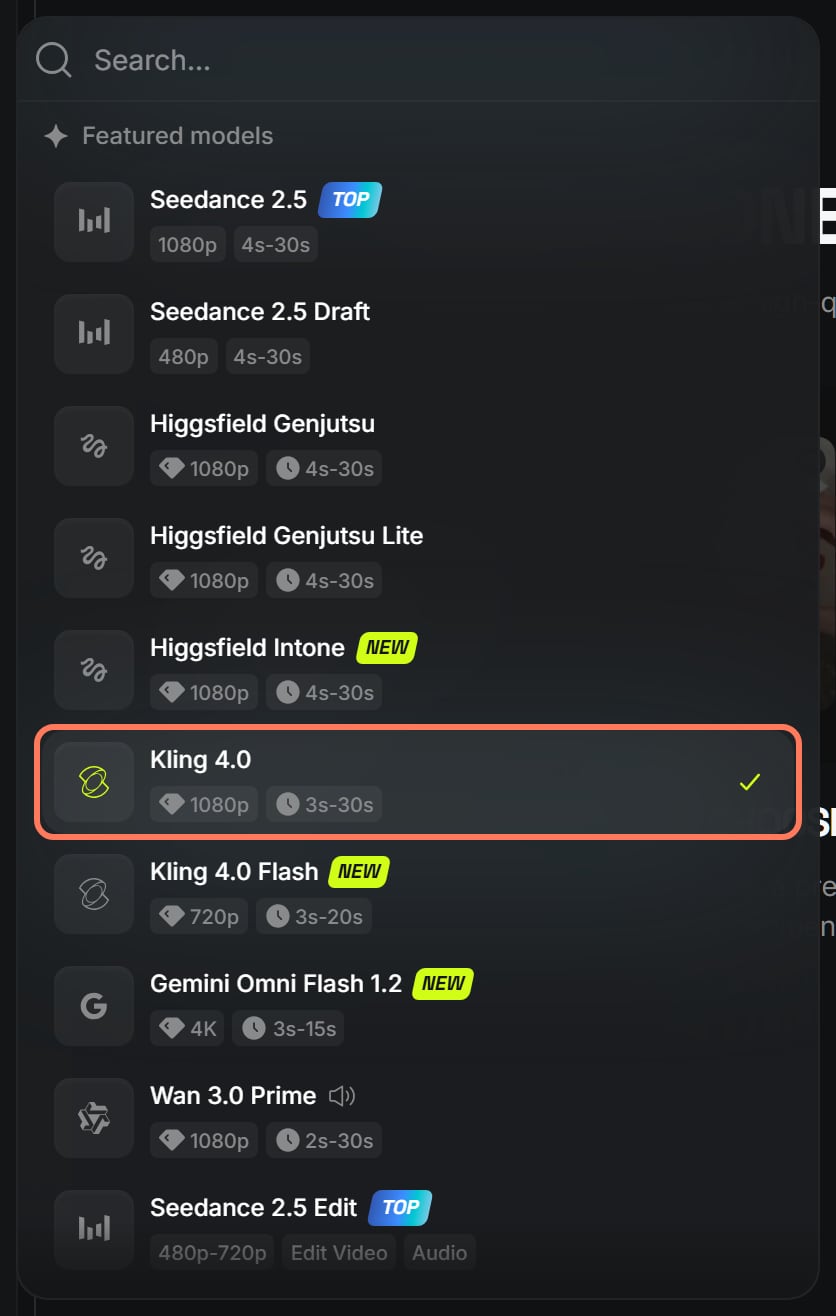
Higgsfield's video model menu (signed out, November 7, 2026): Kling 4.0 sits in the same list as Seedance 2.5 and Wan 3.0 Prime; MiniMax H3, Grok Imagine 1.5 and Google Veo are further down. Outline ours. · Screenshot of higgsfield.ai by aliteq
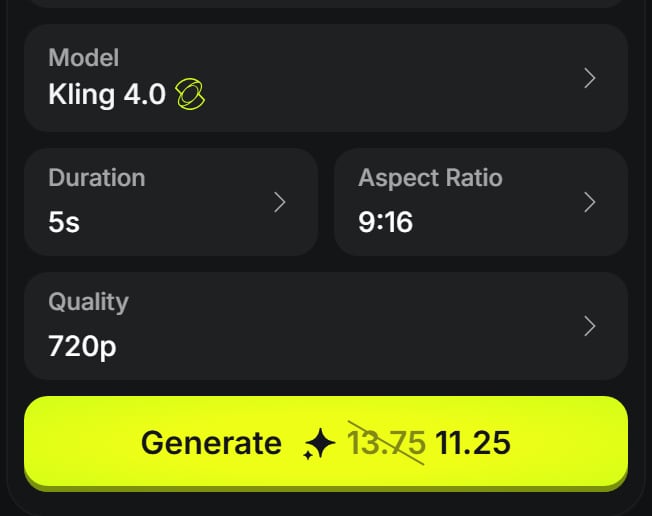
Kling 4.0, 5 s, 9:16, 720p: 11.25 credits, discounted from a listed 13.75 (signed out, November 7, 2026). · Screenshot of higgsfield.ai by aliteq
Seedance 2.5 at the same settings: 35 credits (signed out, November 7, 2026). · Screenshot of higgsfield.ai by aliteq
What our two tests say about switching
We've put Kling against Seedance twice, both times on Higgsfield. Neither test is big enough to rank the models, but both show the trade you'd be making.
Same prompt, same settings, one try each, unedited: Kling 4.0 (top) and Seedance 2.5 (bottom), text-to-video, 5 s, 720p, 9:16, on Higgsfield, November 7, 2026. · Aliteq test, made with Kling 4.0 and Seedance 2.5 on Higgsfield
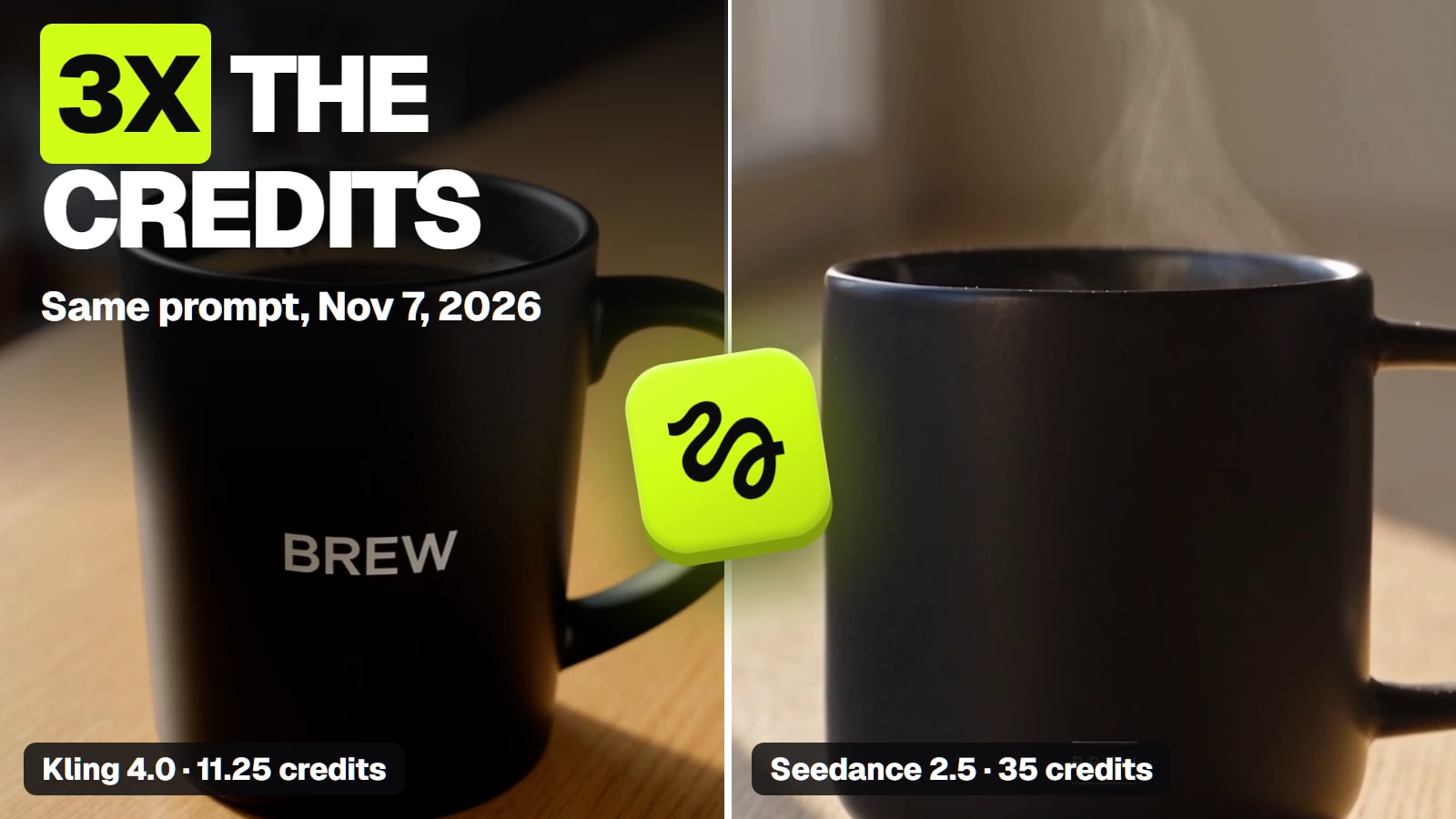
November 7: one prompt, one try each. With the same text prompt for a vertical café ad (it's below, so you can rerun it) at 5 seconds, 720p and 9:16, Kling 4.0 built the café and the soft window light and drew the BREW logo large and readable, for 11.25 credits. Seedance 2.5 kept the logo small, as asked, but barely readable at 720p, set the mug in a plain room and lit it with hard sun stripes, for 35. On this prompt Kling matched the scene for about a third of the credits.
November 3: one product photo, five tries each. Seedance 2.5 kept the product right in 3 of 5 tries against Kling 3.0's 1, and was the only one to build the new grey studio the brief asked for. Three of Kling 3.0's four failed clips broke in the last second, when a hand touched the product.
Our November 7 prompt: run it on the alternative you're weighing
Text-to-video, 5 s, 720p, 9:16
Vertical product ad. A matte black ceramic coffee mug with a small white logo that reads BREW sits on a light oak café counter. A woman's hand slides the mug toward the camera and lets go; steam rises from the coffee. Morning sunlight from a window on the left, soft shadows. Slow push-in camera. Photorealistic, shallow depth of field.
What does each alternative cost per second on Higgsfield?
Inside one platform the models are billed in the same credits, so credits per second is the fairest quick comparison. These are our divisions of Higgsfield's own prices (the Generate button, its cost check, or the credits we were charged), each with the day we read it.
Credits per second of video on Higgsfield (our arithmetic; read date in each label)
MiniMax Hailuo 2.3, 768p (Nov 3)1.0 a second
6 credits for 6 s
Kling 3.0, 720p, sound off (Nov 3)1.5 a second
7.5 credits for 5 s
Veo 3.1 Lite, 720p, sound off by default (Nov 3)1.5 a second
12 credits for 8 s at 16:9 (Higgsfield's Lite default has no sound)
Wan 3.0, 720p (Nov 3)1.8 a second
9 credits for 5 s, 13 listed
MiniMax H3, 2K (Nov 3)2.0 a second
10 credits for 5 s during a discount, 20 listed
Kling 4.0, 720p (Nov 7)2.25 a second
11.25 credits for 5 s on a launch discount (13.75 listed, Nov 7)
Grok Imagine Video 1.5, 720p (Oct 26)4.5 a second
22.5 credits for 5 s
Seedance 2.5, 720p (Nov 7)7.0 a second
35 credits for 5 s, sound included
Veo 3.1, 720p or 1080p (Nov 3)10.0 a second
80 credits for 8 s
To turn the chart into dollars, multiply by what a credit costs you: about 4.9 cents on Plus billed monthly ($59 for 1,200 credits) or 3.3 cents on Ultra billed yearly ($99 for 3,000), assuming you use every credit in the month. On Plus, a second of video comes to about 5 cents on Hailuo 2.3, 11 cents on Kling 4.0 at 720p and 49 cents on Veo 3.1 (our arithmetic). At 1080p, Kling 4.0 was 3.25 credits a second on November 3, a temporary discount on a listed 4 that has been shrinking since launch; what Kling 4.0 costs on Higgsfield, discount by date tracks it. Then multiply by the tries it takes to get one keeper.
Which Kling alternative fits your job?
A product ad that must match the brief (new background, vertical frame): Seedance 2.5 with your product photo as a reference, or stay on Kling and give it a start frame that already shows the background you want.
Cheap drafts to test a prompt: Kling 3.0 Turbo, which Higgsfield's Kling help article (re-read Nov 7) recommends "for drafting and prompt testing before committing to a full render", or Hailuo 2.3 at 6 credits for 6 seconds (Nov 3).
Realistic people and their movement: Seedance. Higgsfield's model guide (re-read Nov 7) sends "realistic human motion" to Seedance and "stylized, cinematic, or long-form video" to Kling.
A realistic shot with dialogue and ambient sound: Veo 3.1, or Grok Imagine Video 1.5 if you're animating a start image.
Continuing a scene from an exact start and end frame: Wan 3.0, though Kling 4.0's keyframes may already cover it.
Editing footage you shot: Runway's Aleph 2.0 is built for it; Seedance 2.5 (billed by the length of your source clip) and Kling 4.0 also edit clips on Higgsfield.
A model you run yourself, no subscription: Wan 2.2's 5B model on a 24 GB GPU. MiniMax H3's weights are public too, but its licence excludes the US.
One take longer than 15 seconds: stay on Kling 4.0 (up to 30), or use Seedance 2.5 or Wan 3.0, both up to 30 on Higgsfield. Veo 3.1 stops at 8, MiniMax H3 and Grok at 15.
How to switch from Kling without wasting credits
Name the reason you're leaving
Queue, free plan, brief, people, length or terms
Rule out a Kling fix first
Failed renders are refunded; fast-track is premium-only
Run your own prompt on two candidates
At the cheapest setting that still shows the motion
Check the last frame, not just the first
Half our failed clips broke in the last second
Price the keeper, then pick the plan
Credits per usable clip, retries included
Our checklist, built from our November 3 and November 7 tests and Kling's Credits Policy (read November 7, 2026).
When should you stay on Kling?
More often than most "alternatives" lists admit. Check these before you switch:
Price per second. Kling 3.0 is among the cheapest models on Higgsfield per second, and on November 7 Kling 4.0 cost about a third of Seedance 2.5's rate at 720p (the chart above), though its price has moved with a launch discount since October 21.
Length and control. Kling's own Kling 4.0 guide, dated November 4, 2026, lists clips of "3-30s", "up to 10 keyframe inputs", "up to 15 reference assets", editing of "up to 5 video clips" and "two-channel stereo" audio, at up to 4K on kling.ai. On Higgsfield it runs at 720p or 1080p with up to seven Kling elements. Kling marks video extension to "up to 2 minutes" as coming soon.
Your scene came out right. In our November 7 test Kling 4.0 rendered the café setting and soft light the prompt asked for, at a third of Seedance's credits.
The problem was the queue or a failed render. Kling refunds failed generations and keeps fast-track for paying members, so the fix may be a plan, not a model.
Kling is most of your work. Then Kling's own plans usually cost less per clip, most clearly for a team: about $1.47 for the 5-second 4K Kling 3.0 clip priced above on Kling's Team plan, against $2.37 on Higgsfield Team, both billed monthly (our arithmetic, Nov 3, 2026).
Names you'll see on other "Kling alternative" lists
Sora 2 (OpenAI): gone. OpenAI discontinued the Sora app and website on April 26, 2026 and the Sora API on September 24, 2026, and its model page says "There is no one-to-one replacement API" (OpenAI's pages, read Nov 3, 2026). Sora wasn't in Higgsfield's model catalogue on November 7 either.
Pika: not in Higgsfield's catalogue on November 7. On November 3 a 5-second 720p Pika 2.5 clip was 20 Pika credits, about $0.22 on Pika's $10-a-month Starter plan (900 credits), and Pika's Free plan doesn't include a commercial licence. Pika sells Kling 4.0 too, at 118 credits per 5 seconds at 1080p (Nov 3).
Gemini Omni (Google): Google's own page says "Gemini Omni will replace Veo in the Gemini app", where making videos needs a paid Google AI plan (read Nov 3, 2026). Higgsfield's catalogue listed Gemini Omni Flash 1.1 and 1.2 on November 7, both with native audio; we haven't priced or tested them.
Kling's own lighter models: Kling 4.0 Flash (720p, 3 to 20 seconds, per Kling's guide) and Kling 3.0 Turbo are on Higgsfield too. The cheapest switch is sometimes to another Kling.
What we couldn't verify
Quality beyond Kling and Seedance. We've only run Kling against Seedance. For Veo, MiniMax, Wan, Grok and Runway, the "best at" lines are the makers' or Higgsfield's words, not our judgment.
Today's price for every model. On November 7 we re-read only Kling 4.0 (5 seconds at 720p, 10 at 1080p) and Seedance 2.5 (5 seconds at 720p and 1080p) on the Generate button. Seedance 2.5 at 480p, Kling 3.0, Veo, Hailuo, MiniMax H3 and Wan are from November 3 and Grok's from October 26, and several were discounts at the time.
Veo 3.1 Lite's sound. We don't know whether Higgsfield's November 3 price of 12 credits for Veo 3.1 Lite included sound; its catalogue sets Lite's audio off by default.
Grok on Higgsfield. Higgsfield priced "Grok Imagine Video 1.5" on October 26; on November 7 its catalogue listed Grok Video 1.5 and Grok Imagine Video 1.5 Lite, which we didn't re-price. xAI's "Try for free" link to grok.com states no limits.
Wan 2.6 weights. Higgsfield's catalogue calls Wan 2.6 "Open-weight"; on November 7 Alibaba's Hugging Face page and the Wan 2.2 GitHub showed no Wan 2.6 weights.
MiniMax H3 on one GPU. MiniMax publishes no single-GPU VRAM figure for H3; its sample commands use four GPUs.
Kling 4.0's price on kling.ai. Kling's Kling 4.0 guide publishes no credit cost per clip, so we can't price the same Kling 4.0 clip on Kling's own site.
Speed. Our timings come from one run each, and queues change by the hour.
Verdict
Pick by the reason you're leaving
Don't leave Kling for a list; leave it for a reason. If Kling keeps your photo's scene when you need a new one, or your people look off, try Seedance 2.5 and accept about three times the credits per second. For realistic clips with sound in 8-second takes, Veo 3.1, cheapest through Google's own plans. For exact start and end frames or a model on your own GPU, Wan. For cheap, fast drafts, Hailuo. If the problem was the queue or the price, fix it inside Kling first, or keep Kling and add the others on one plan.
Best for: Kling users deciding whether, and where, to switch
Frequently asked
What is the best alternative to Kling AI?
It depends on why you're leaving. Seedance 2.5 suits realistic people and new scenes built around a product photo (3 of 5 usable clips in our Nov 3, 2026 product test, against 1 of 5 for Kling 3.0), Google's Veo 3.1 suits realistic clips with native sound of up to 8 seconds, Wan 3.0 suits exact first and last frames, and MiniMax's Hailuo suits cheap, fast drafts. If the problem is Kling's queue or its price, a paid Kling plan or a multi-model plan may fix it without switching models.
Is there a free alternative to Kling AI?
Several, each with a catch. Google Flow gives 50 credits a day (read Nov 3, 2026), enough for a few Veo 3.1 Lite or Fast clips but not a 100-credit Quality clip, with peak-hour limits for non-subscribers and a Google page that lists a paid plan as a requirement. Dreamina gives US free accounts 120 credits a day (Nov 3, 2026), about 3 seconds of Seedance 2.5, and its own pages disagree on whether free credits cover 2.5. Hailuo gives a one-time welcome pack that expires after three days, and Alibaba's Wan site gives daily check-in credits. The open Wan 2.2 is free to run on your own GPU.
Which Kling alternative makes the longest clips?
On Higgsfield (model catalogue read Nov 7, 2026), Seedance 2.5 and Wan 3.0 match Kling 4.0's 30 seconds in one take, while MiniMax H3 and Grok Video 1.5 stop at 15 seconds, Hailuo at 10 and Veo 3.1 at 8. Seedance 2.5 can also extend a finished clip forward or backward on Higgsfield; Kling's guide lists its own extension, up to 2 minutes, as coming soon.
Which Kling alternative can I run on my own computer?
Wan 2.2, Alibaba's open model under the Apache 2.0 licence. Its GitHub README (read Nov 7, 2026) says the 5B model can run on a GPU with at least 24GB of VRAM, such as an RTX 4090, while the 14B sample commands are written for at least 80GB. Wan 3.0 has no open weights. MiniMax H3's weights are on Hugging Face too, but its community licence excludes the US, the EU, the UK and South Korea, and MiniMax's sample setup uses four GPUs.
What is cheaper than Kling?
On Higgsfield on Nov 7, 2026, Kling 4.0 was 2.25 credits a second at 720p. At prices read Nov 3, Hailuo 2.3 (1 a second at 768p), Kling 3.0 with sound off and Veo 3.1 Lite at its silent default (1.5 each) cost less. Wan 3.0 (1.8) and MiniMax H3 at 2K (2) did too, but only at that day's discounts (2.6 and 4 at list). Seedance 2.5 (7) and Veo 3.1 (10) cost more. If Kling is most of what you make, Kling's own plans usually cost less per clip than any multi-model plan. That's our arithmetic, and the Generate button shows the current price.
Is Sora still an alternative to Kling?
No. OpenAI discontinued the Sora app and website on April 26, 2026 and the Sora API on September 24, 2026, and says there is no one-to-one replacement. Sora wasn't in Higgsfield's model catalogue on Nov 7, 2026 either.
Can I use Kling and its alternatives on one plan?
Mostly, on Higgsfield, which runs Kling 4.0 and 3.0 next to Seedance, Veo, MiniMax, Wan and Grok on one credit plan; Runway's own models, Pika and Sora weren't in its catalogue on Nov 7, 2026. Plus costs $59 a month for 1,200 credits (pricing page, Nov 3, 2026) and is the cheapest plan whose card lists all models. If Kling is most of your work, Kling's own plans usually cost less per clip.