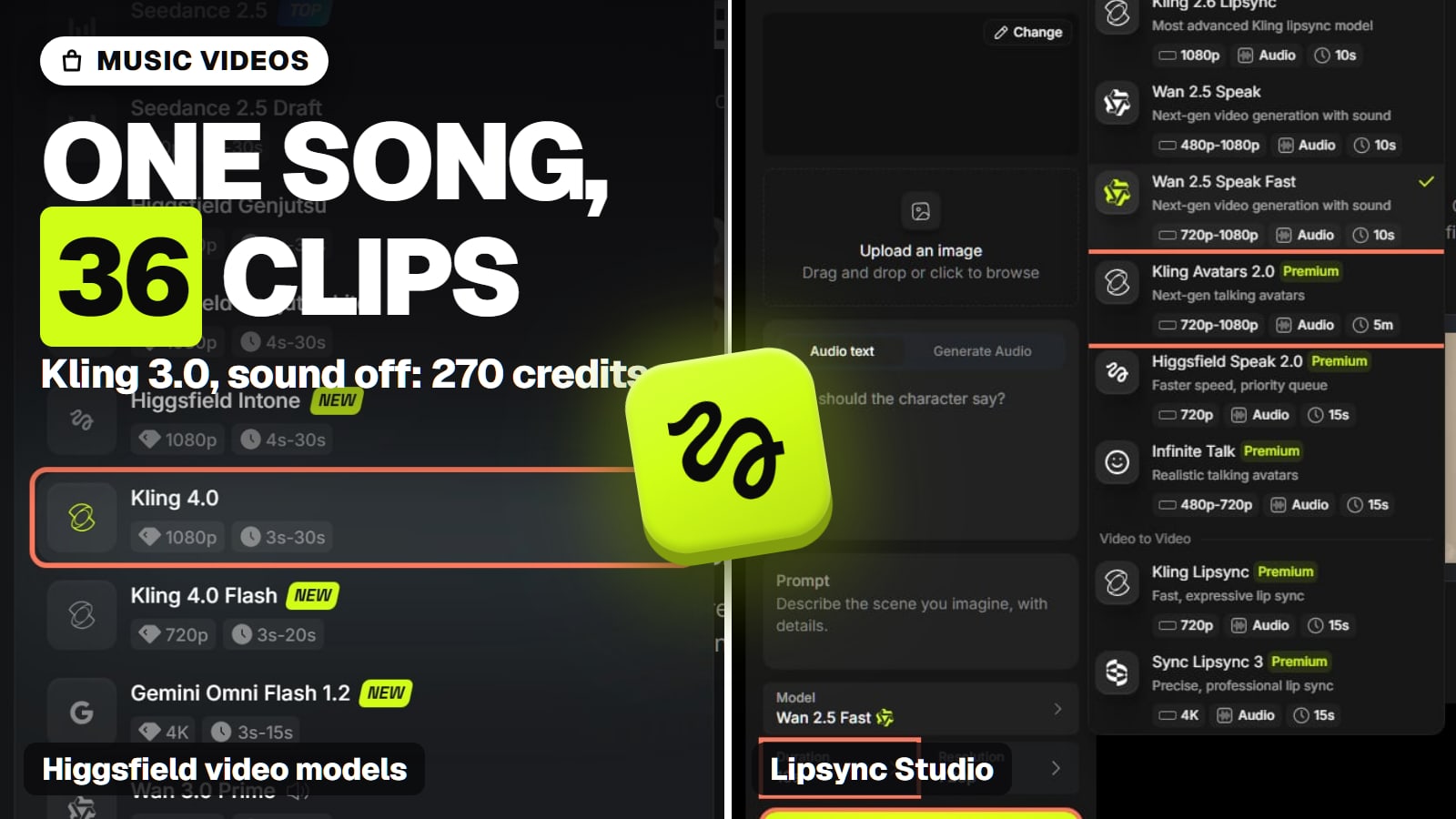
Kling 3.0 with its sound off for the visuals, cut to your own track, plus Sync Lipsync 3 for the shots where the singer's mouth must match: about 270 credits of footage for a 3-minute song on Higgsfield. Which models take your song as input, which make their own music, and the rights you need.
Some links on this page are referral links: we may earn a commission, at no cost to you.
Share
The best AI music video generator for most musicians is two tools, not one: Kling 3.0 with its sound switched off for the visuals you cut to your own track, and Higgsfield's Sync Lipsync 3 for the few shots where a singer's mouth has to match the vocal. A 3-minute song is 180 seconds of footage, or 36 five-second clips: about 270 credits on Kling 3.0 at 7.5 credits a clip (Higgsfield's Generate button, Nov 3, 2026), against about 1,260 on Seedance 2.5. We read every model's audio options on the makers' and Higgsfield's own pages between November 3 and November 8, 2026. Other jobs, from Shorts to animation, are on our best AI video generator hub.
How many AI clips does a 3-minute song need, and what do they cost?
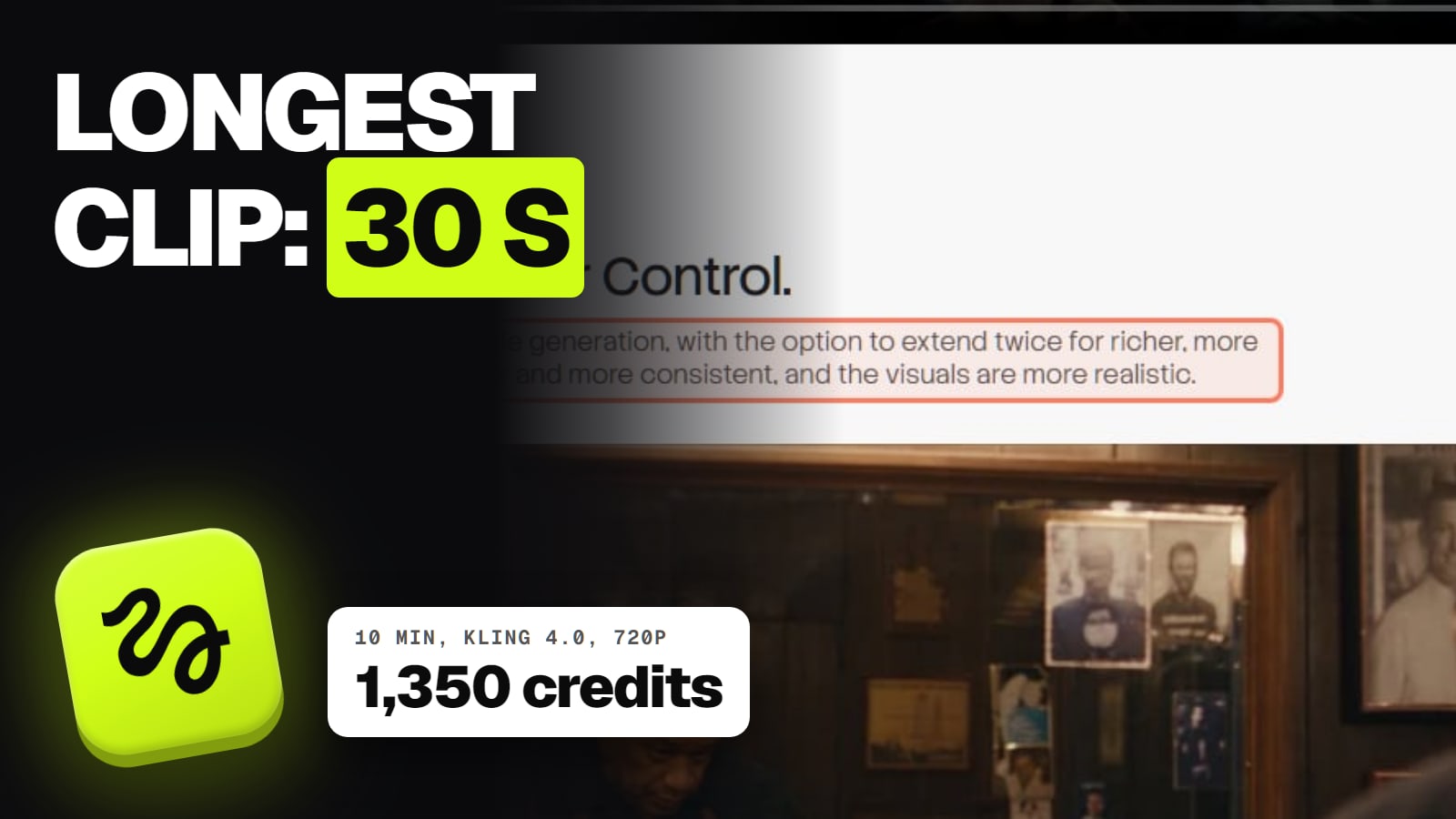
Every video model has a ceiling on one take, so a song is always several generations. The table counts the minimum takes for a 180-second song and prices 180 seconds of footage at 720p, first tries only, from the credit price Higgsfield's Generate button showed on the date in the source list (our arithmetic). The last column is the question people mix up most: can the model take your song as an input at all?
Filling a 3-minute song, by model (our arithmetic from Higgsfield prices, Nov 2026)
Kling 3.0, sound off
Longest take, minimum takes
15 s, 12 takes
180 s of footage
About 270 credits
Takes your song as input
No; start and end frame only
Its own sound
Optional; off costs less
Grok Imagine 1.5 Lite
Longest take, minimum takes
15 s, 12 takes
180 s of footage
About 180 credits
Takes your song as input
No (Grok Video 1.5 takes audio references)
Its own sound
Always on
Hailuo 2.3, 768p
Longest take, minimum takes
10 s, 18 takes
180 s of footage
About 180 credits (6 s clips)
Takes your song as input
No
Its own sound
Not verified
Veo 3.1 Lite
Longest take, minimum takes
8 s, 23 takes
180 s of footage
About 276 credits
Takes your song as input
No
Its own sound
Off by default on Higgsfield
Wan 3.0
Longest take, minimum takes
30 s, 6 takes
180 s of footage
About 324 credits
Takes your song as input
Yes, audio references
Its own sound
On by default, toggle
Kling 4.0
Longest take, minimum takes
30 s, 6 takes
180 s of footage
About 405 credits (discounted rate)
Takes your song as input
No audio input on Higgsfield
Its own sound
Stereo always; may add background music
Seedance 2.5
Longest take, minimum takes
30 s, 6 takes
180 s of footage
About 1,260 credits
Takes your song as input
Yes, up to 10 audio clips
Its own sound
On by default, toggle at the same price
Longest take, minimum takes
180 s of footage
Takes your song as input
Its own sound
Kling 3.0, sound off
15 s, 12 takes
About 270 credits
No; start and end frame only
Optional; off costs less
Grok Imagine 1.5 Lite
15 s, 12 takes
About 180 credits
No (Grok Video 1.5 takes audio references)
Always on
Hailuo 2.3, 768p
10 s, 18 takes
About 180 credits (6 s clips)
No
Not verified
Veo 3.1 Lite
8 s, 23 takes
About 276 credits
No
Off by default on Higgsfield
Wan 3.0
30 s, 6 takes
About 324 credits
Yes, audio references
On by default, toggle
Kling 4.0
30 s, 6 takes
About 405 credits (discounted rate)
No audio input on Higgsfield
Stereo always; may add background music
Seedance 2.5
30 s, 6 takes
About 1,260 credits
Yes, up to 10 audio clips
On by default, toggle at the same price
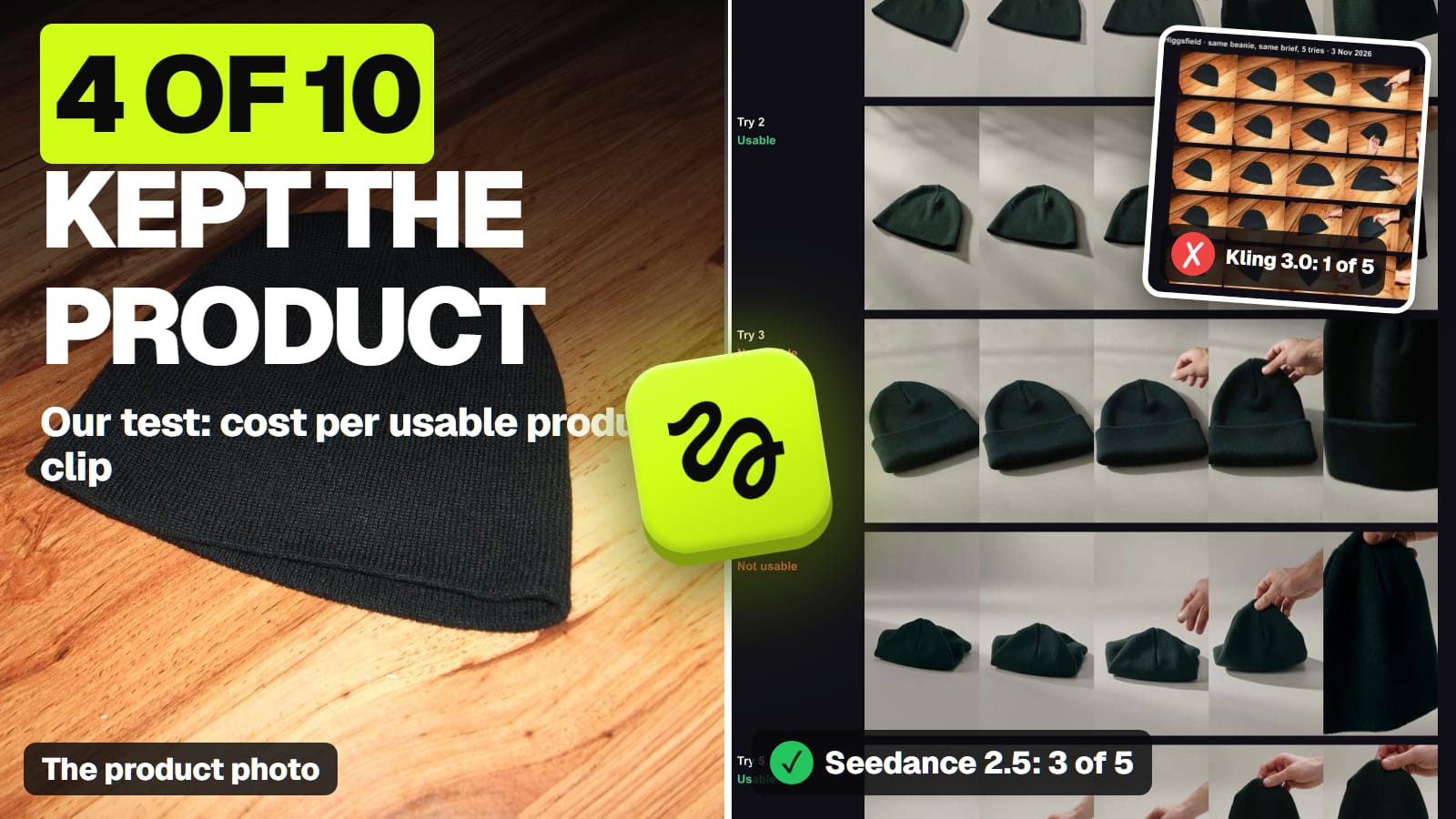
In dollars, Kling 3.0's 270 credits are about $13 of Higgsfield Plus credit ($59 for 1,200), and Seedance 2.5's 1,260 are about $62, more than a month of Plus. Real projects cost more: music videos throw away a lot of takes, and in our product-ad test one in five Kling 3.0 tries and three in five Seedance 2.5 tries met a strict brief. A full song with a retry for every clip roughly doubles the figures above, which puts a Kling 3.0 video at about 540 credits: inside Plus, but past Starter's 270.
Why Kling 3.0 and not the cheaper rows? Grok Imagine 1.5 Lite and Hailuo 2.3 cost less per second, but Lite always generates sound you'll throw away and Hailuo's 768p is the lower resolution. Kling 3.0 is the cheapest model here that takes a start and an end frame and lets you turn the sound off ("Use 'off' for silent video and lower credits", per Higgsfield's catalogue), so each clip can begin on the frame the previous one ended on, which keeps a video's look steady across 36 cuts.
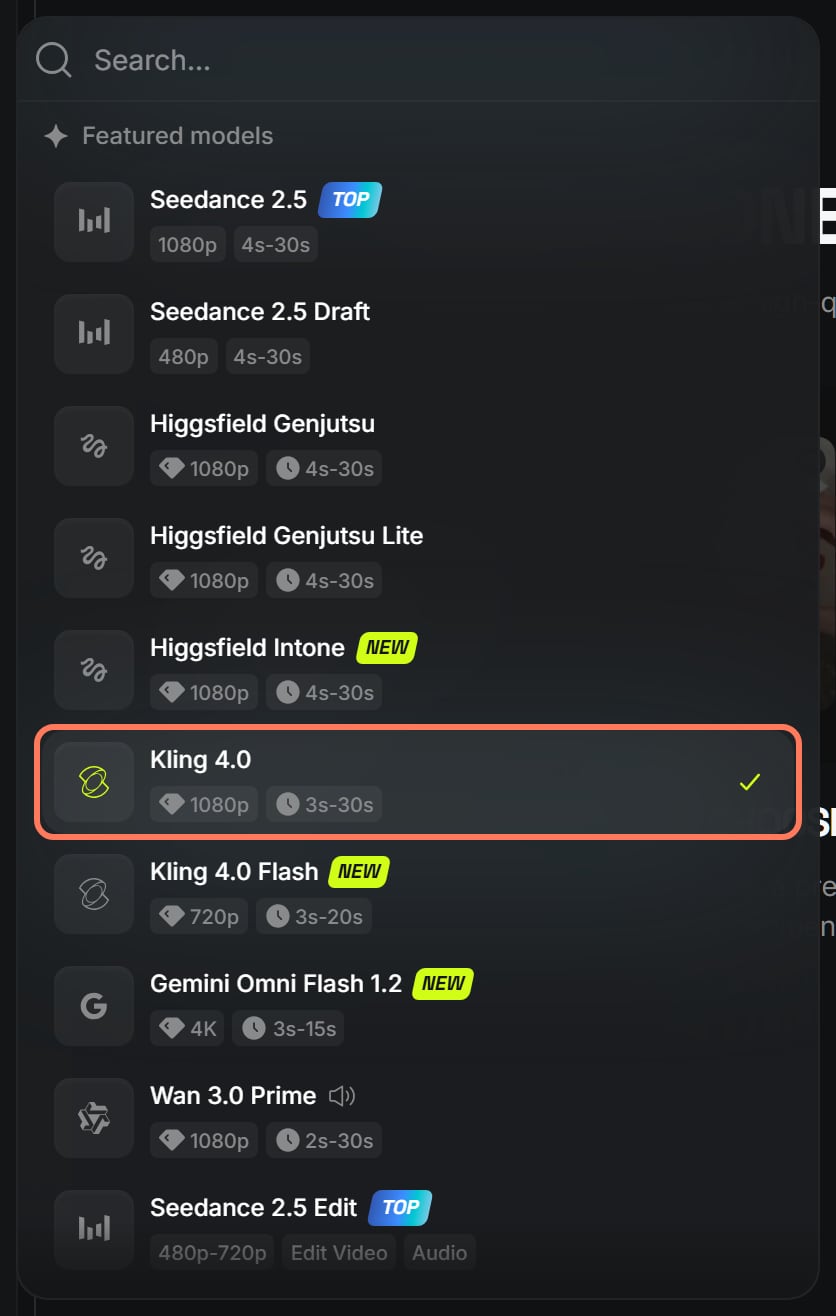
Higgsfield's video model menu (signed out, November 7, 2026). Kling, Seedance, Wan and Intone sit on one credit balance; Sync Lipsync 3 lives in Lipsync Studio. Outline ours. · Screenshot of higgsfield.ai by aliteq
Can an AI music video lip-sync to your song?
Sometimes, with the right tool. There are three different things people mean, and they need different tools.
1. Re-syncing a performer's mouth to your vocal. This is a video-to-video job. Higgsfield's help center lists Sync Lipsync 3 as "Precise lip sync, up to 4K" for existing footage, and its catalogue shows it takes two inputs, a video and an audio track, with five ways to handle a length mismatch: bounce, loop, cut off, pad with silence or retime the video. Lipsync Studio's model list showed it at up to 4K and 15 seconds a take when we read it on November 3. So the workflow is: generate the singer's shot on any model with sound off, then run it through Sync Lipsync 3 with the matching section of your song, 15 seconds at a time. We didn't record its credit price and haven't run it on singing.
2. A model that takes the song as a reference. Seedance 2.5 accepts up to 10 audio clips as references in one generation per ByteDance's model page, and Higgsfield's catalogue lists audio references for Seedance 2.0, Wan 3.0, Wan 2.7, MiniMax H3, Grok Video 1.5 and Cinema Studio 4.0. None of their makers' pages that we read says the model will lip-sync a sung vocal; treat it as something to test with one 5-second clip before committing a song.
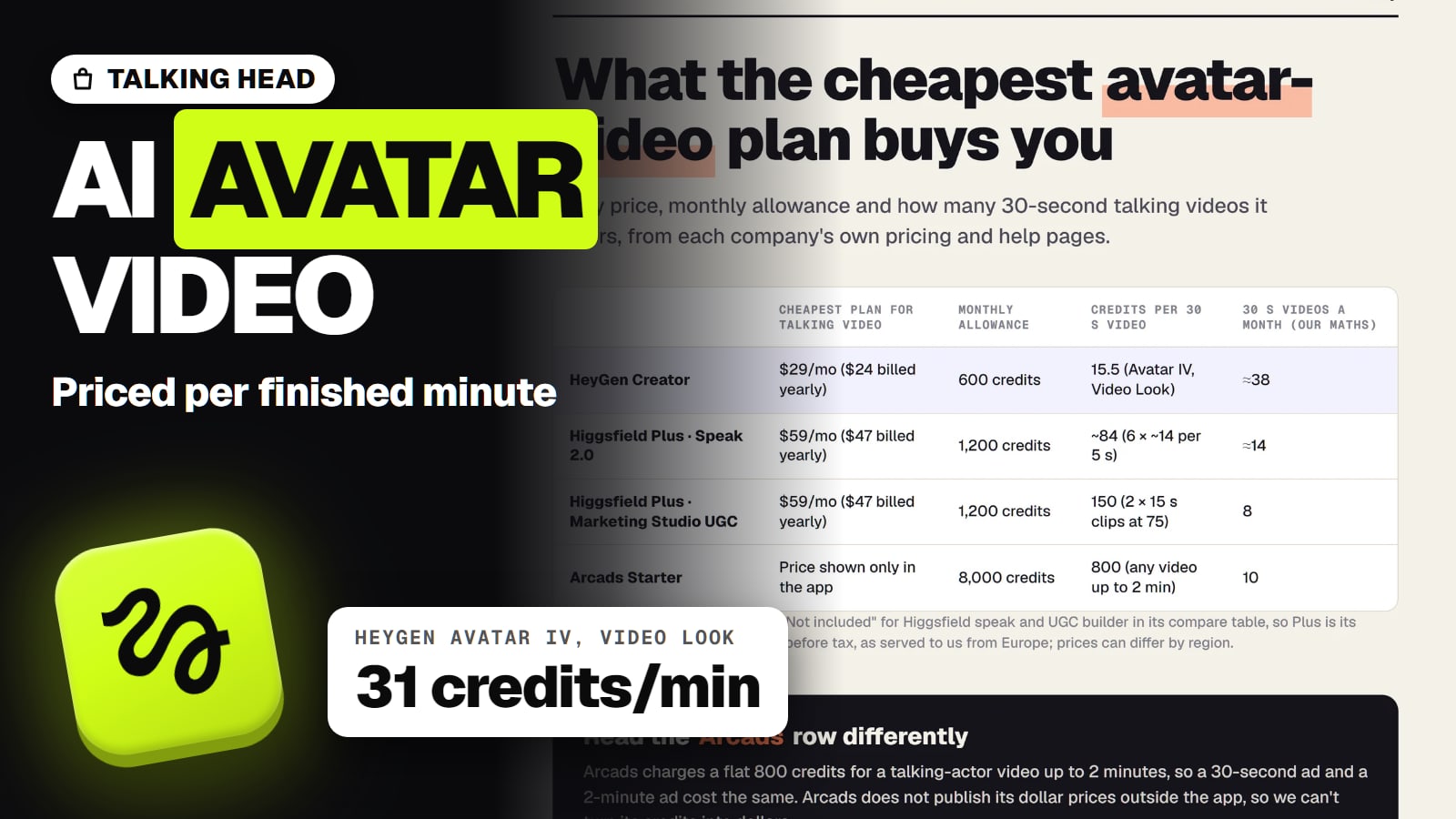
3. Talking-head tools. Higgsfield Intone makes one or two characters speak one to six voice recordings, 2 to 30 seconds of voice in total, per its catalogue description, and Lipsync Studio's image-to-video models start from text you type for the character to say. They're built for speech, and nothing on Higgsfield's pages mentions singing. Talking-avatar videos in Higgsfield prices them.
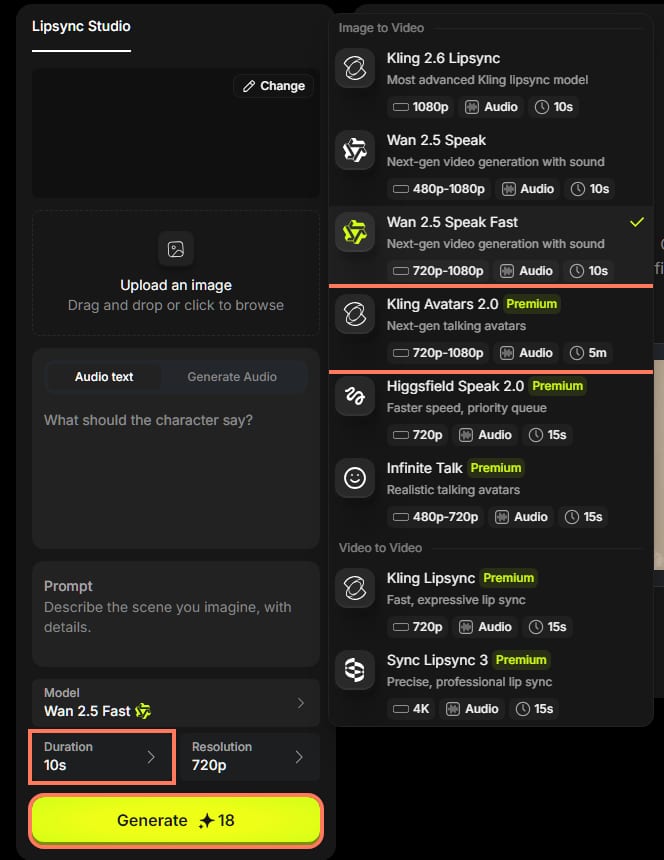
Higgsfield's Lipsync Studio, read November 3, 2026, signed out. Most models here take 10 or 15 seconds at a time; Kling Avatars 2.0 lists up to 5 minutes. All are built for speech; none mentions singing. Outline ours. · Screenshot of higgsfield.ai by aliteq
For an open-source route, Alibaba's Wan 2.2 includes S2V-14B, a speech-to-video model that animates from an input speech track (Wan2.2 README, Apache 2.0). It runs on your own or a rented GPU; cloud GPUs for ComfyUI covers running Wan 2.2 on a rented card. We haven't tried S2V on singing either.
Don't confuse a video model's sound with your song
Several video models now make their own audio, and some make music. That's a soundtrack for the clip, not your track:
Kling 4.0 generates stereo sound with every clip, with no switch, and Kling's guide says it may add background music by default.
Wan 2.7, per Alibaba's API reference, "generates matching background music or sound effects" when you give it no audio.
Veo 3.1 adds sound effects, ambient noise and dialogue natively, per Google DeepMind.
Seedance 2.5 is described by ByteDance as an "audio-video joint generation model".
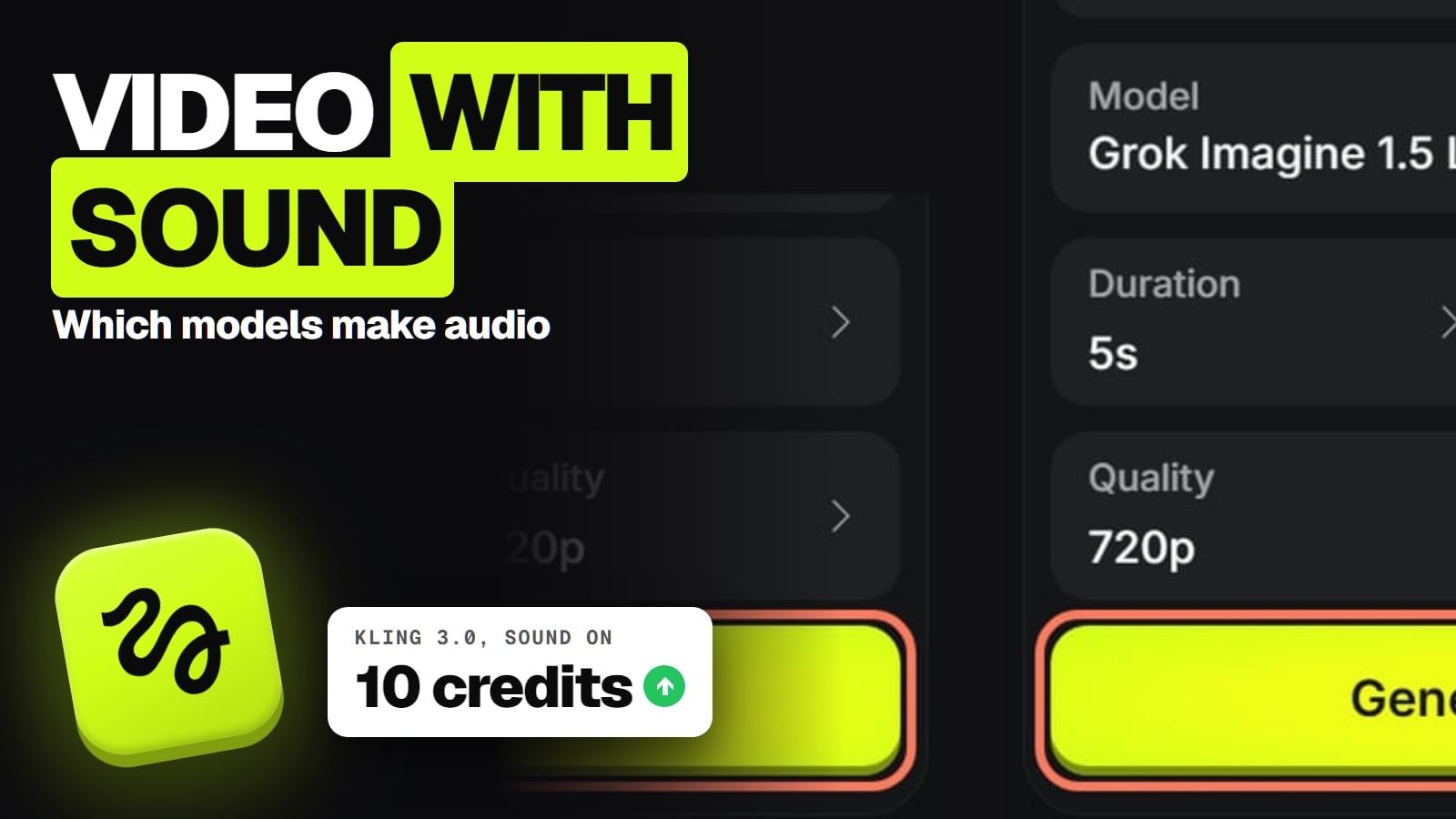
For a music video, switch the sound off where you can (Kling 3.0, Wan 3.0, Seedance 2.5, Veo 3.1 Lite) and lay your master over the edit. On Kling 3.0 that also saves credits; on Seedance 2.5 the price is the same either way.
If you don't have a song yet, that's a music generator's job, not a video model's. Higgsfield's own model guide sends "a complete sound scene: voice, music, and effects in one pass" to Seed Audio, and its catalogue also lists a music model that writes from a prompt or custom lyrics (up to 120 seconds with custom lyrics). We haven't tested either for a release-ready track.
Who owns the music, and what do platforms require?
Your upload must be yours. Higgsfield's Terms of Use (last updated October 23, 2026), section 4.2, say that when you upload content you represent that "you have all necessary rights to Your Content" and that it "does not infringe or violate the copyright" of anyone else. Section 3.1 makes you "entirely responsible" for what you upload. Upload your own master or a track you've licensed for video, never a commercial song you just like.
The video is yours to use. Section 4.4 says Higgsfield "does not claim ownership" of your inputs or outputs and doesn't restrict commercial use of outputs (Higgsfield commercial use has the details, including a conflicting line in its compare table about free accounts). That covers the AI footage; your song's licence is separate.
A real singer's voice or face needs consent. Section 5.3 says that for audio or images containing a person's voice or face, you represent you've obtained all consents required by law.
Labels. Meta's help center lists "A song created using AI-generated vocals" among the examples that need an AI label on Facebook, Instagram and Threads. If the video looks realistic, YouTube asks you to disclose it too (YouTube's altered or synthetic content label).
Short teasers. YouTube lets most songs run up to 90 seconds in a Short, and blocks any Short over one minute with an active copyright claim until it's resolved.
The best AI video generator for other jobs
Each page below answers one job from the same checked facts. All of them, grouped by job, are in our best AI video generator guide.
Best AI anime video generator: Kling 4.0: its maker documents animation styles, and it takes 10 reference images of your own character.
What we couldn't verify
Lip-sync to singing. No vendor page we read says any model or lip-sync tool handles sung vocals, and we haven't run one. Test a 5-second section before a whole song.
Sync Lipsync 3's price. We didn't record a credit price. Its 15-second take comes from Lipsync Studio's model list on November 3; Higgsfield's help page states no audio length limit.
Whether a long take costs exactly six 5-second ones. Our figures scale Higgsfield's 5-second prices.
Whether Wan 3.0's sound toggle lowers its price. Not checked.
Hailuo 2.3's sound. Neither MiniMax nor Higgsfield states it.
Where Kling 4.0's default background music comes from. Kling doesn't say, so we can't tell you whether it could ever draw a copyright claim.
Quality on music videos. Our only video tests are a product ad and one prompt on Kling 4.0 and Seedance 2.5. The pick rests on price, the sound switch and frame control.
4/ 10
Verdict
Kling 3.0 footage plus a lip-sync pass
For a music video built around your own song, use Kling 3.0 with sound off for the footage, about 270 credits for three minutes before retries, and Sync Lipsync 3 for the shots where a singer's mouth must match the vocal. Use Seedance 2.5 or Wan 3.0 when you want the model to hear the song, and test one short section first, because no vendor promises lip-synced singing. Whatever you use, upload only music you have the rights to.
Best for: Independent musicians and editors making a music video for a song they own or have licensed
AI music videos: common questions
What is the best AI music video generator?
For most musicians, Kling 3.0 with sound off on Higgsfield for the visuals, about 270 credits for 180 seconds of footage at 720p before retries (our arithmetic from Higgsfield's Nov 3, 2026 price), plus Sync Lipsync 3 for shots where the singer's lips must match the vocal.
Can AI make a music video from my song?
It can make the footage, and some models take audio as a reference: Seedance 2.5 accepts up to 10 audio clips, and Wan 3.0 and MiniMax H3 also take audio references on Higgsfield. No vendor we read promises lip-synced singing, so test a short section first, or generate the footage silent and lip-sync it afterwards.
How many AI clips does a 3-minute music video need?
At least 6 takes on models that run 30 seconds (Kling 4.0, Seedance 2.5, Wan 3.0), 12 on 15-second models (Kling 3.0, Grok Imagine), 18 on Hailuo 2.3 and 23 on Veo 3.1. In practice music videos cut every few seconds, so you'll make more, shorter clips.
Can I use a famous song in an AI music video?
Not without a licence. Higgsfield's terms say you represent that you have all necessary rights to what you upload and that it doesn't infringe anyone's copyright. Use your own master or a track licensed for video.
Does the AI video generator make the music too?
Some video models generate their own sound: Kling 4.0 may add background music by default, Wan 2.7 generates matching music or effects when given no audio, and Veo 3.1 makes effects and ambience. That's not your song. Music generators are separate tools; Higgsfield's catalogue lists some.
Do AI music videos need a label?
Meta lists a song created using AI-generated vocals among the content that needs an AI label on Facebook, Instagram and Threads, and YouTube asks you to disclose realistic AI-generated content.
The short version: treat your song as the master, generate silent footage on the cheapest model that holds a look across cuts, and add lip-sync only where a mouth is on screen. On Higgsfield that's Kling 3.0 plus Sync Lipsync 3.